Top 10 duck breeds to hatch in the UK
Duck eggs take a week longer than hens' eggs, and the wait is worth it. These ten cover the range: tiny, noisy Calls, bolt-upright Runners, heavy white Aylesburys and a black duck whose first eggs of the year come out black.
- Indian Runner
- Call Duck
- Khaki Campbell
- Aylesbury
- Pekin
- Cayuga
- Muscovy
- Welsh Harlequin
- Silver Appleyard
- Magpie
| Breed | Egg colour | Eggs a year | Days to hatch | Temperament |
|---|---|---|---|---|
| Indian Runner | White to blue-green | 250+ in good strains | 28 | Active and busy |
| Call Duck | Pale green | Around 100 | 28 | Talkative, very loud |
| Khaki Campbell | White | 230 to 300+ | 28 | Lively forager |
| Aylesbury | White to green-tinted | 35-125 | 28 | Slow-moving, very tame |
| Pekin | White | 150-200 (BWA) | 28 | Not recorded |
| Cayuga | Black, fading to white | 50-150 | 28 | Calm, quiet, hardy |
| Muscovy | White | 8-10 per clutch | 35 | Calm when domesticated |
| Welsh Harlequin | White | 240-330 quoted | 28 | Docile, inquisitive |
| Silver Appleyard | White | 220-265 | 28 | Lively but calm |
| Magpie | White, green or blue | 180-290 | 28 | Active, can be highly strung |
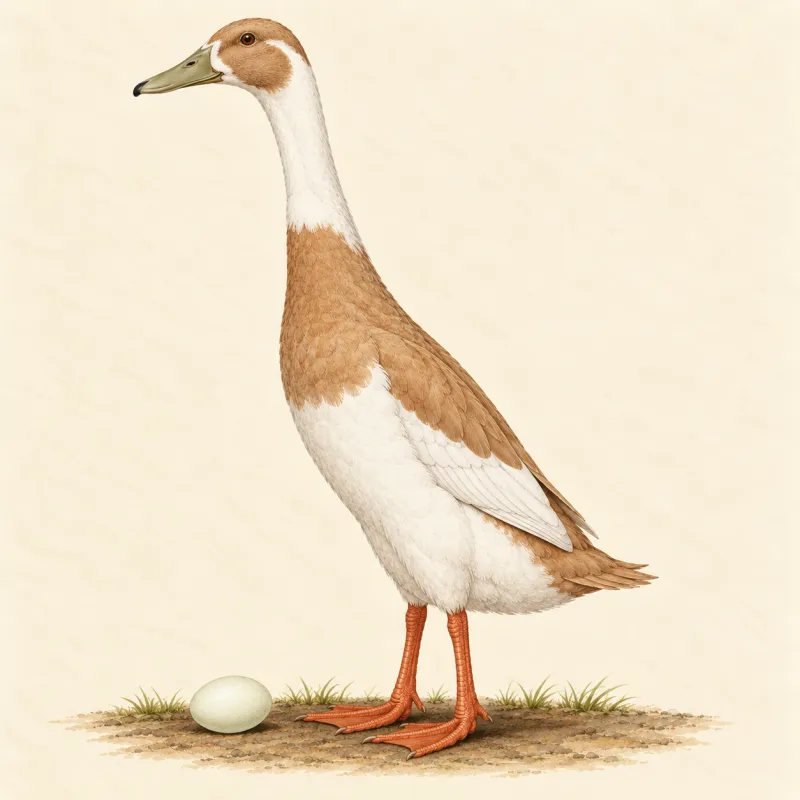
1 Indian Runner
The upright duck that runs rather than waddles: an egg layer turned garden slug patrol.
Item specifics: Indian Runner
- Egg colour
- White to blue-green
- Eggs a year
- Over 250 from good laying strains; exhibition strains often fewer
- Days to hatch
- 28
- Size
- Light and upright, about 1.4-2.3 kg
- From
- East Indies (Indonesia): Lombok, Java and Bali
- Temperament
- Active and busy; can be highly strung unless handled from ducklings
- UK status
- Popular show and garden duck; not on the RBST watchlist
Why keepers love it: Indian Runner
Nothing else in the duck pen stands like a Runner. The carriage is upright, nearly perpendicular when the bird is at attention, and a drake measures 65 to 80 cm from bill tip to toe. The breed came from the East Indies, reached Britain in about 1835 by British accounts (the Livestock Conservancy says around 1850) and now has fourteen standard colours, from White and Fawn to Chocolate and Apricot Trout. Nearly all the light duck breeds, the Khaki Campbell among them, carry Runner blood.
Hatching: Indian Runner
Runner eggs range from pearly white to blue-green, and both colours can come from ducks in one breeding trio. They take about 28 days. Runners rarely go broody, so many breeders turn to a broody hen or an incubator. The ducklings are lively from the start: the breeder David Holderread lifts them out of the incubator slowly so that they do not jump overboard.
Keeping: Indian Runner
Runners are content in a flock, not much given to flying and easy to manage, though they can scramble over a two to three-foot fence. They do not strictly need swimming water but enjoy it. Ducks have the loud quack; the club suggests three ducks to one drake. The warning is about eggs: many new keepers expecting a heavy layer are disappointed, and the club blames over-breeding for exhibition.
Checked against: British Waterfowl Association (Runner Duck, Incubation), The Poultry Club of Great Britain, Indian Runner Duck Club (Indian Runner Duck Standards 2008, History of the Indian Runner Duck, Colour of Runner Duck Eggs, Making the Ideal Decorative Duck Pond, Duck or Drake?, Frequently Asked Questions, High Egg Production in Runners), The Livestock Conservancy, Cornell University Duck Research Laboratory, Scientific Papers. Series D. Animal Science, USAMV Bucharest, Wikipedia, Rare Breeds Survival Trust.
Look for Indian Runner duck hatching eggs on Broody Back to the ten ducks
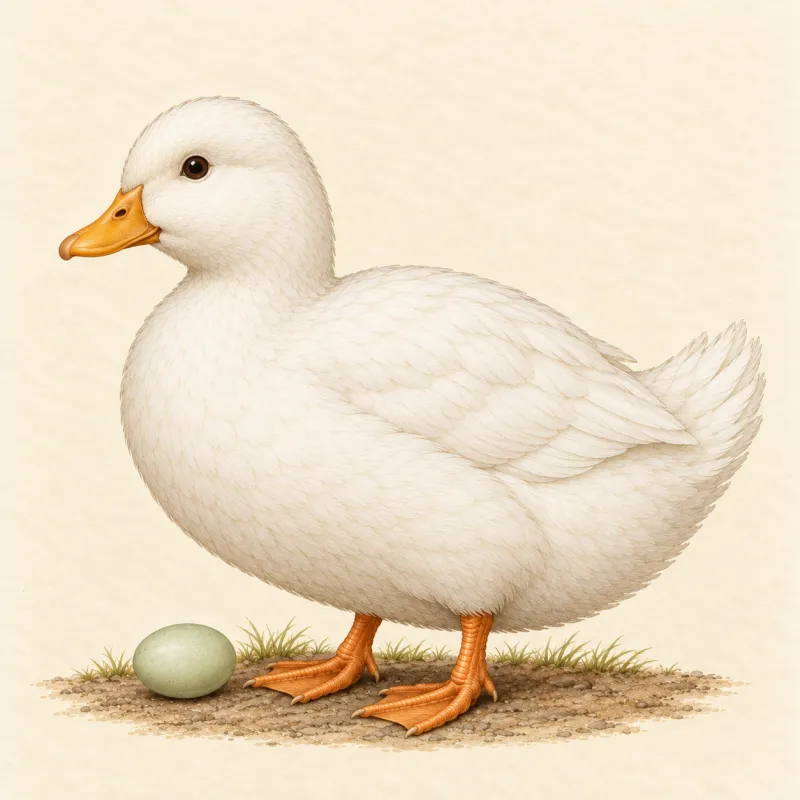
2 Call Duck
The smallest domestic duck, under a kilo, in nineteen standard colours, with a very loud quack.
Item specifics: Call Duck
- Egg colour
- Pale green
- Eggs a year
- Around 100
- Days to hatch
- 28
- Size
- Bantam; under 1 kg
- From
- Netherlands, possibly from stock imported from Asia
- Temperament
- Talkative; the ducks are very loud
- UK status
- Probably the most popular domestic duck today (BWA)
Why keepers love it: Call Duck
Calls were bred to be heard. Small and easily carried, they were used to call wild Mallard down to the decoy traps of the Fens and the Dutch marshes. White and grey Calls were in the first British poultry standard of 1865. Today the British Waterfowl Association reckons the Call is probably the most popular domestic duck, usually the largest entry at a show, with nineteen standardised colours and a round head and very short bill.
Hatching: Call Duck
Call ducks are not great layers. The British Waterfowl Association describes clutches of 8 to 12 eggs, and The Poultry Site puts the year's total at around 100, pale green; neither the British Waterfowl Association nor the Poultry Club breed page gives an egg colour. A duck left to sit will hatch and mother her clutch with great care. Incubation is about 28 days. The ducklings are tiny, and the Indian Runner Duck Club's rearing notes single them out: pick each one up in the first week to check it is clean, and avoid chick crumbs containing coccidiostats.
Keeping: Call Duck
The quack is the catch. The British Waterfowl Association advises against keeping female Calls where there are close neighbours. Otherwise the breed suits a small space and eats less than bigger ducks. Showing is harder: the BWA calls Calls cheap to keep but really difficult to breed to a winner, and warns that colours run together produce birds that will not breed true.
Checked against: British Waterfowl Association (Call Ducks, Domestic Ducks, First Time?), The Poultry Club of Great Britain, Indian Runner Duck Club (Rearing Ducklings, Frequently Asked Questions), Wikipedia, The Poultry Site, Cornell University Duck Research Laboratory, Rare Breeds Survival Trust.
Look for Call Duck hatching eggs on Broody Back to the ten ducks
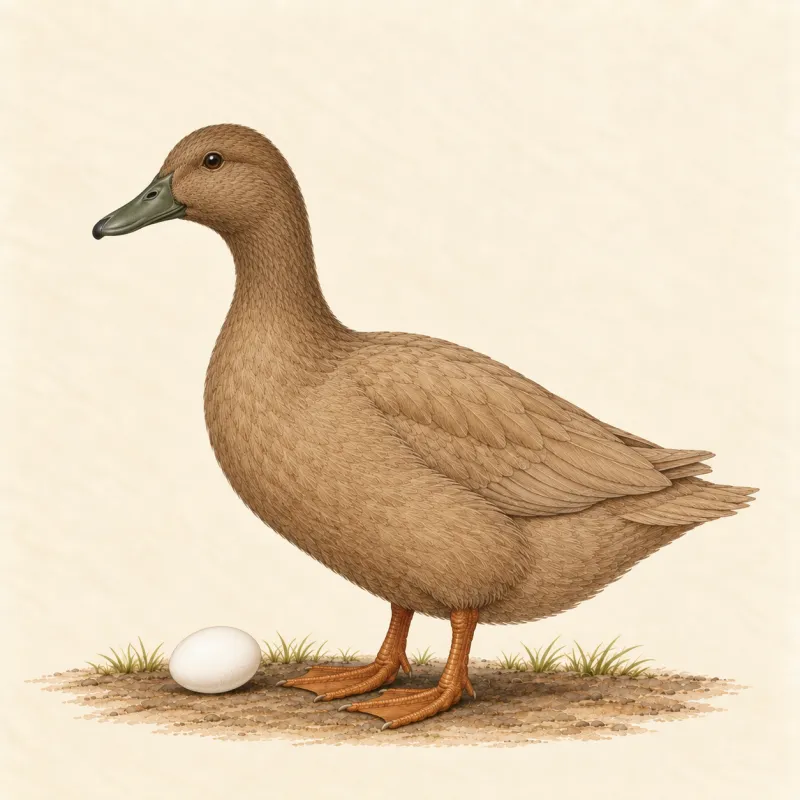
3 Khaki Campbell
The laying duck from Gloucestershire: mud-coloured, busy, and good for 300 eggs a year in the best strains.
Item specifics: Khaki Campbell
- Egg colour
- White, sometimes tinted
- Eggs a year
- 230 to over 300, depending on strain
- Days to hatch
- 28
- Size
- Light; drakes 2.3-2.5 kg, ducks 2.0-2.3 kg
- From
- Uley, Gloucestershire, England
- Temperament
- Lively, energetic forager
- UK status
- RBST priority breed, listed as Campbell (2026-27 watchlist)
Why keepers love it: Khaki Campbell
Mrs Adele Campbell of Uley in Gloucestershire bred for eggs, not shows. She put a Rouen drake to a Fawn and White Runner duck, added a little Mallard blood, and by about 1901 had the khaki variety, which the Poultry Club describes as the colour of farmyard mud. It largely took over as the top egg-laying duck, with some utility strains laying over 300 eggs a year, and it gave rise to the Welsh Harlequin and the Abacot Ranger.
Hatching: Khaki Campbell
Campbell eggs are white, sometimes tinted, and take about 28 days. The Poultry Club calls the breed very fertile, yet a Bucharest university flock that recorded about 90% fertility in 2019-20 still saw only 58% hatchability, a fair warning before a first hatch. Cross a Khaki drake with a Dark Campbell duck and the ducklings sort themselves: khaki females, dark-looking males.
Keeping: Khaki Campbell
Campbells are lively foragers that make short work of slugs and snails, and they want space to graze. Most start laying at five to seven months. Not every brown duck is one: the BWA warns that many generic brown ducks are passed off as Khaki Campbells. The real thing has no eye stripes, a speculum that is never brightly coloured, and drakes of 2.3 to 2.5 kg.
Checked against: British Waterfowl Association, The Poultry Club of Great Britain, Rare Breeds Survival Trust (Campbell, Watchlist: ducks, Watchlist), The Livestock Conservancy, Scientific Papers. Series D. Animal Science, USAMV Bucharest, Wikipedia, Cornell University Duck Research Laboratory.
Look for Khaki Campbell duck hatching eggs on Broody Back to the ten ducks
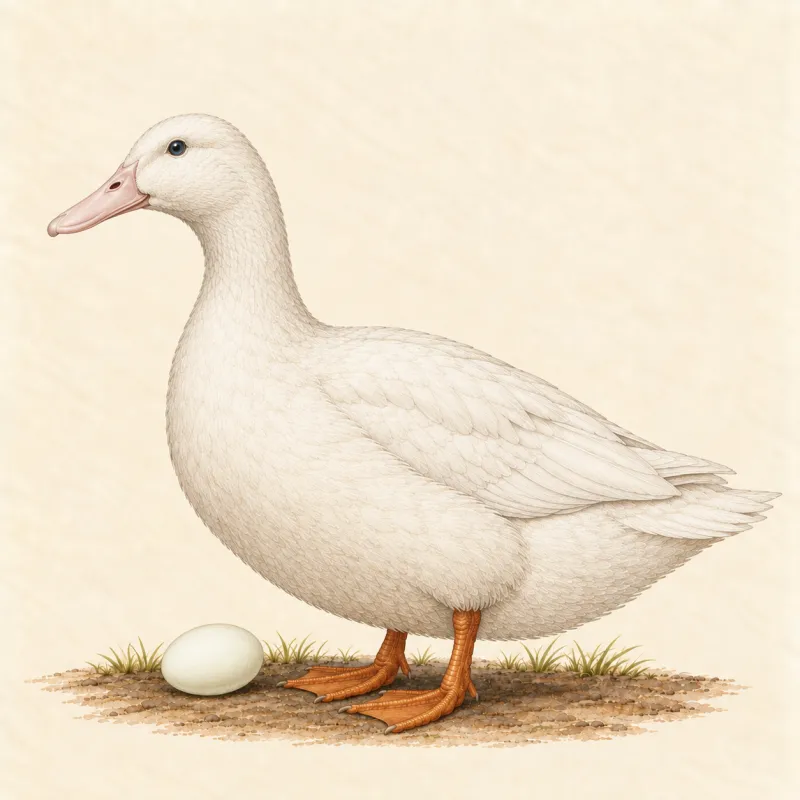
4 Aylesbury
The big white table duck of Buckinghamshire, pink-billed and deep-keeled, and rarer than it looks.
Item specifics: Aylesbury
- Egg colour
- White to green or blue tinted
- Eggs a year
- 35-125; BWA says 80-100
- Days to hatch
- 28
- Size
- Heavy; drakes 4.5-5.4 kg, ducks 4.1-5.0 kg
- From
- Aylesbury, Buckinghamshire, England
- Temperament
- Slow-moving and exceptionally tame
- UK status
- RBST priority breed (2026-27 watchlist)
Why keepers love it: Aylesbury
Aylesbury became a byword for big white ducks in the eighteenth century, and residents of the town's Duck End reared ducklings in their own homes for the London market. The exhibition bird that followed is a heavy white duck with a long, flesh-pink bill and a keel that touches the ground at rest; a good drake passes five kilos. A white duck with a yellow bill is not an Aylesbury, whatever it is called, so the real thing is much rarer than many imagine.
Hatching: Aylesbury
This is not an easy bird to breed. The RBST says relatively few eggs are laid and fertility is often lower than in other breeds, because the drake's keel can interfere with mating; exhibition birds with the deepest keels find natural mating hardest. Incubation is 28 days. The old Aylesbury duckers did not let the ducks sit, and put the eggs under broody hens.
Keeping: Aylesbury
Aylesburys are slow-moving, exceptionally tame and not good foragers, and The Livestock Conservancy lists them as prone to bumblefoot. Egg numbers are modest: 80 to 100 a year by the British Waterfowl Association's count, 40 to 100 by the RBST's, with shells from white to green or blue tinted. Drakes weigh 4.5 to 5.4 kg and ducks 4.1 to 5.0 kg.
Checked against: British Waterfowl Association, The Poultry Club of Great Britain, Rare Breeds Survival Trust (Aylesbury, Watchlist: ducks, Watchlist), The Livestock Conservancy, Wikipedia, Cornell University Duck Research Laboratory.
Look for Aylesbury duck hatching eggs on Broody Back to the ten ducks
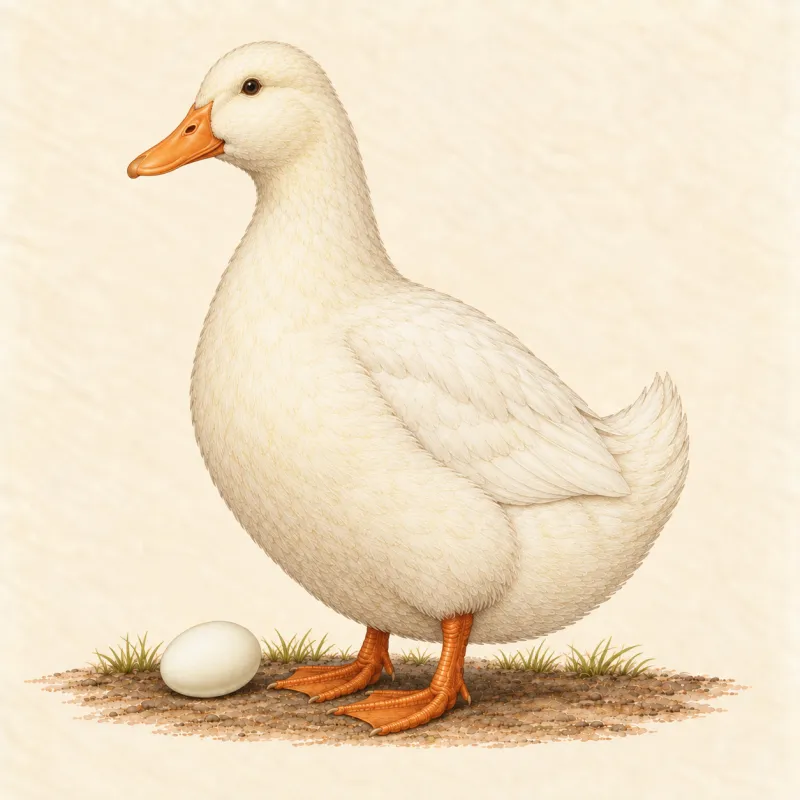
5 Pekin
The upright white duck from China with a yellow sheen, and the base stock of commercial table ducks.
Item specifics: Pekin
- Egg colour
- White or tinted
- Eggs a year
- 150-200 (BWA)
- Days to hatch
- 28
- Size
- Heavy; drakes 4.1 kg, ducks 3.6 kg
- From
- China; imported to Britain in 1872
- UK status
- RBST priority breed (2026-27 watchlist)
Why keepers love it: Pekin
Big white ducks known in China as ten-pound ducks reached Britain in 1872 and America in 1873. American breeders made theirs the source of the US table-bird industry. In Britain and Europe the Pekin stayed upright, and today's exhibition strain, often called the German Pekin, has a thick neck and dense, fluffy white plumage with a yellow sheen that is enhanced by maize in the feed. A drake weighs about 4.1 kg. Commercial white ducks share the ancestry but not the standard.
Hatching: Pekin
Pekin eggs take 28 days; Cornell's duck laboratory moves them from setter to hatcher on day 25. The British Waterfowl Association rates the breed a reasonable layer for a heavy duck, at 150 to 200 eggs a year. Not every fertile egg hatches: a Bucharest university flock recorded 87% fertility and 55% hatchability in 2019-20, with eggs averaging about 78 g.
Keeping: Pekin
The RBST describes the shape as a small, wide boat standing almost on its stern. Bill, legs and feet are bright orange and the eyes blue. Exhibitors protect the yellow tinge by limiting strong sunlight, which bleaches it. Pekins grow fast: Cornell records well-fed birds reaching about 90% of adult weight at seven weeks. Like all waterfowl, they need water deep enough to immerse the whole head.
Checked against: British Waterfowl Association (Pekin, First Time?), The Poultry Club of Great Britain, Rare Breeds Survival Trust (Pekin, Watchlist: ducks, Watchlist), Cornell University Duck Research Laboratory (Hatching Duck Eggs, Domestic Ducks), Wikipedia, Scientific Papers. Series D. Animal Science, USAMV Bucharest.
Look for Pekin duck hatching eggs on Broody Back to the ten ducks
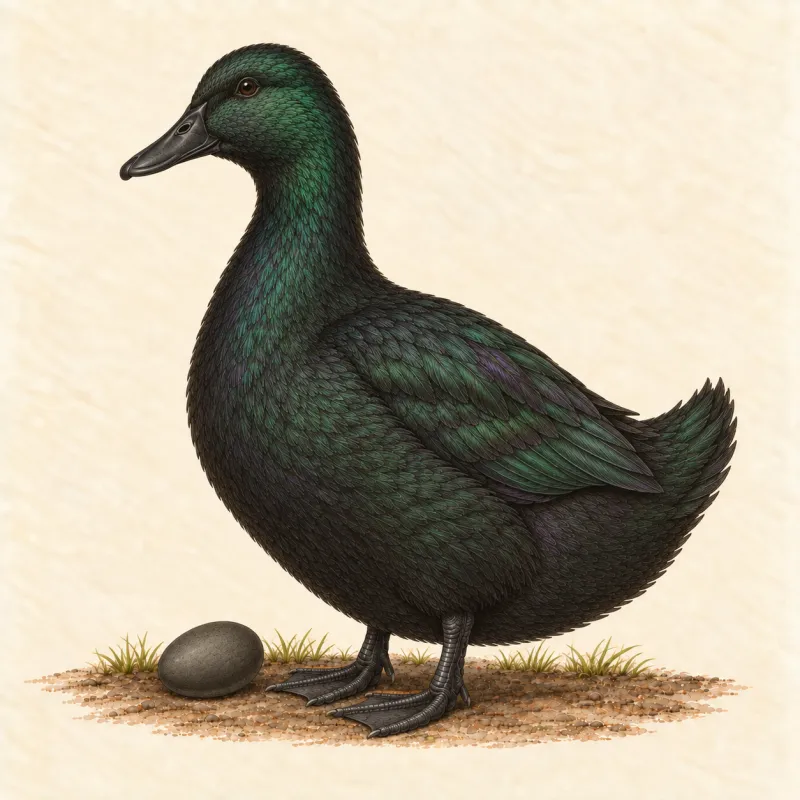
6 Cayuga
A black duck with a beetle-green sheen whose first eggs of the season are coated in dark pigment.
Item specifics: Cayuga
- Egg colour
- Black at first, fading to white through the season
- Eggs a year
- 50-150 (BWA 50-100; Livestock Conservancy 100-150)
- Days to hatch
- 28
- Size
- Heavy; drakes 3.6 kg, ducks 3.2 kg
- From
- New York State, USA
- Temperament
- Calm, quiet and hardy
- UK status
- RBST priority breed (2026-27 watchlist)
Why keepers love it: Cayuga
In good daylight a Cayuga is black with a brilliant green iridescence, produced by the structure of the feathers scattering light rather than by green pigment. The breed takes its name from Cayuga Lake in New York State and was standardised in America in 1874 and in Britain in 1901. The surprise is in the nest: early eggs carry a dark coat that wipes off to show a green shell, and the colour fades as the season goes on.
Hatching: Cayuga
Incubation is 28 days. Egg numbers are modest: 50 to 100 a year by the British Waterfowl Association's figure, 100 to 150 by The Livestock Conservancy's. Black is dominant over wild colour in ducks, but two black birds can each carry the hidden wild-colour gene, so a wild-coloured duckling can appear in a hatch from black parents.
Keeping: Cayuga
Like other heavy breeds the Cayuga is generally calm and easy going, and The Livestock Conservancy calls it a quiet breed and one of the hardiest domestic ducks. Drakes weigh 3.6 kg and ducks 3.2 kg. The drawback for showing is age: ducks can develop white patches as they get older, and the BWA notes that the birds with the brightest sheen tend to turn white earliest.
Checked against: British Waterfowl Association (Cayuga, First Time?), The Poultry Club of Great Britain, Rare Breeds Survival Trust (Cayuga, Watchlist: ducks, Watchlist), The Livestock Conservancy, Cornell University Duck Research Laboratory, Wikipedia.
Look for Cayuga duck hatching eggs on Broody Back to the ten ducks
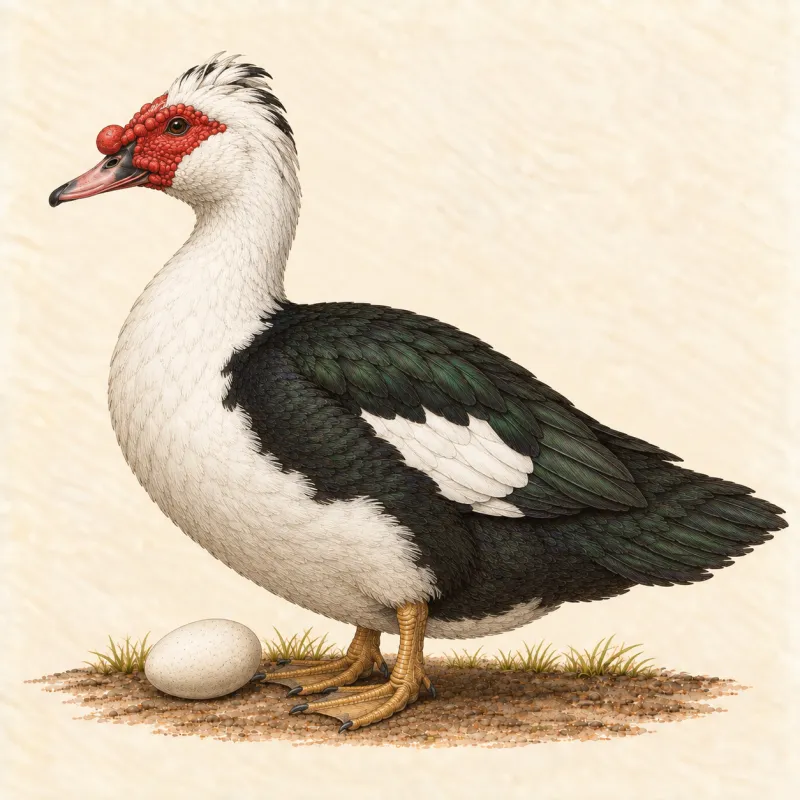
7 Muscovy
A separate species: a big, quiet, perching duck with a red face, whose eggs take 35 days, not 28.
Item specifics: Muscovy
- Egg colour
- White
- Eggs a year
- Low; about 8-10 eggs per laying effort, 2-3 times a year
- Days to hatch
- 35
- Size
- Heavy; drakes 4.5-6.3 kg, ducks 2.3-3.2 kg
- From
- Central and South America
- Temperament
- Quiet and calm when domesticated; ducks defend their young
- UK status
- Standardised heavy duck; not on the RBST watchlist
Why keepers love it: Muscovy
Every other domestic duck descends from the Mallard. The Muscovy comes from a different wild species, Cairina moschata, native to Central and South America, where it was domesticated long before Columbus. It shows in the bird: a bare red face with caruncles that develop with age, a crest it can raise, and webbed feet with strong claws, suited to perching as much as swimming. Drakes weigh 4.5 to 6.3 kg and ducks 2.3 to 3.2 kg. Crosses with common ducks are sterile.
Hatching: Muscovy
Muscovy eggs need about 35 days, a week longer than mallard-derived breeds. The duck is the specialist: the British Waterfowl Association says the Muscovy is prized as a broody, and Cornell's duck laboratory calls Muscovies very good setters, capable of hatching 12 to 15 duck eggs. Breeders use them to hatch other waterfowl too. A broody Muscovy will defend her young with heart and soul.
Keeping: Muscovy
Muscovies are quiet: the drake has a low, breathy call and the duck a quiet trilling coo. Domesticated birds have calm temperaments, but the Poultry Club describes a powerful bird requiring careful handling. They fly well, and wild Muscovies roost in trees at night. They tolerate hot weather much better than common ducks. Laying is modest, about 8 to 10 eggs per laying effort.
Checked against: British Waterfowl Association (Muscovy (domestic), Domestic ducks, Incubation), The Poultry Club of Great Britain, Cornell University Duck Research Laboratory (Domestic Ducks, Hatching Duck Eggs), Animal Diversity Web, University of Michigan Museum of Zoology, Rare Breeds Conservation Society of New Zealand, Wikipedia, Rare Breeds Survival Trust.
Look for Muscovy duck hatching eggs on Broody Back to the ten ducks
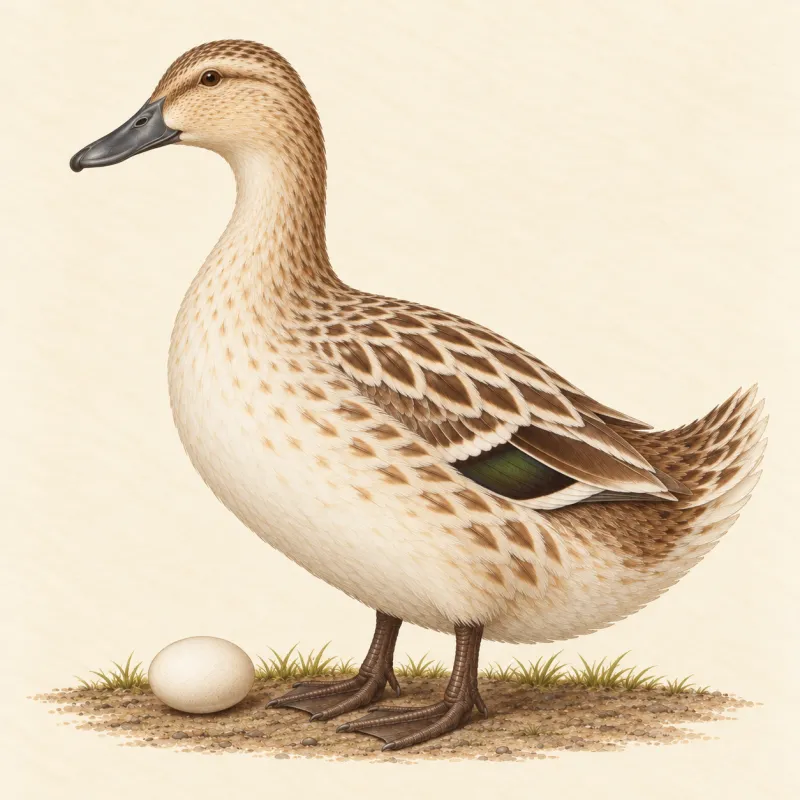
8 Welsh Harlequin
A 1949 colour sport from Khaki Campbells: a light, docile, quiet duck that lays white eggs.
Item specifics: Welsh Harlequin
- Egg colour
- White, sometimes tinted
- Eggs a year
- 240-330 quoted (RBST); BWA says 'passably good layers'
- Days to hatch
- 28
- Size
- Light; about 2.3-2.5 kg (5-5.5 lb)
- From
- Hertfordshire, England, then Criccieth, Wales (1949)
- Temperament
- Docile, active and inquisitive
- UK status
- RBST priority breed (2026-27 watchlist)
Why keepers love it: Welsh Harlequin
In 1949 two light-coloured ducklings hatched among Group Captain Leslie Bonnet's Khaki Campbells. He bred from them, first as Honey Campbells, then as Welsh Harlequins once the family had moved to Criccieth in north-west Wales. After the late 1960s the breed was saved from virtual extinction by Edward Grayson in Lancashire, who bred Bonnet-strain birds back to Khaki Campbells. Genetically it is almost identical to the Campbell. The drake has a greenish-black head, the duck a creamy white head with brown stippling.
Hatching: Welsh Harlequin
Eggs are white, sometimes tinted, and take about 28 days. Watch the bills on hatch day: The Livestock Conservancy notes that duck and drake ducklings may show a subtle sex-linked difference in bill colour. Laying figures of 240 to 330 eggs a year are quoted by the RBST, but the British Waterfowl Association's own verdict is cooler: passably good layers.
Keeping: Welsh Harlequin
This is one of the quieter duck breeds. The Livestock Conservancy describes Harlequins as docile, inquisitive birds that do not fly, enjoy interacting with people and are easily trained to range by day and come in at night. They are active foragers and do well in heat and cold given suitable housing and clean water. For breeding, the Conservancy advises against birds with distinct mallard-like facial stripes.
Checked against: British Waterfowl Association, The Poultry Club of Great Britain, Rare Breeds Survival Trust (Welsh Harlequin, Watchlist: ducks, Watchlist), The Livestock Conservancy, Cornell University Duck Research Laboratory.
Look for Welsh Harlequin duck hatching eggs on Broody Back to the ten ducks
9 Silver Appleyard
Reginald Appleyard's 1930s all-rounder: a heavy duck bred for looks, big white eggs and the table.
Item specifics: Silver Appleyard
- Egg colour
- White
- Eggs a year
- 220-265 (Livestock Conservancy)
- Days to hatch
- 28
- Size
- Heavy; drakes 3.6-4.1 kg, ducks 3.2-3.6 kg
- From
- Suffolk, England, 1930s
- Temperament
- Lively and active, with a calm temperament
- UK status
- RBST priority breed (2026-27 watchlist)
Why keepers love it: Silver Appleyard
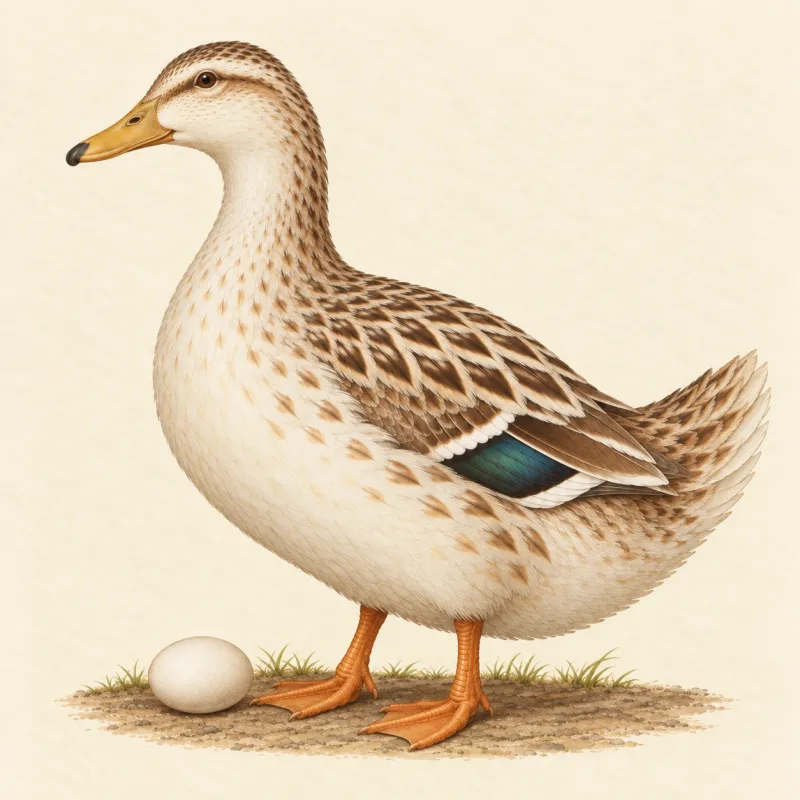
Reginald Appleyard, who also created the Ixworth chicken, set out in the 1930s to make the best all-round farmyard duck: beauty, size, lots of big white eggs and a deep, wide breast. First shown in the 1940s, it was not standardised until 1982, when the standard followed a painting commissioned from Ernest Wippell in 1947. The drake's green head is stamped with silver eyebrows and throat. The RBST calls it well worth considering as a first breed.
Hatching: Silver Appleyard
Eggs are large and white and take about 28 days. This is one of the best layers among the heavy ducks, averaging 220 to 265 eggs a year according to The Livestock Conservancy. Growth is quick: the Poultry Club records Appleyard's table bird reaching 3 kg, plucked, at nine weeks. When choosing breeders, size matters, because many Appleyards are undersized.
Keeping: Silver Appleyard
The RBST calls the Silver Appleyard a lively and active bird; The Livestock Conservancy adds that it forages actively, has a calm temperament and tends to stay close to home if well fed. Drakes weigh 3.6 to 4.1 kg and ducks 3.2 to 3.6 kg. The bill is yellow, with a greenish tint in males, and the duck is creamy white, flecked and streaked in fawn and brown-grey.
Checked against: British Waterfowl Association, The Poultry Club of Great Britain, Rare Breeds Survival Trust (Silver Appleyard, Watchlist: ducks, Watchlist), The Livestock Conservancy, Wikipedia, Cornell University Duck Research Laboratory.
Look for Silver Appleyard duck hatching eggs on Broody Back to the ten ducks
10 Magpie
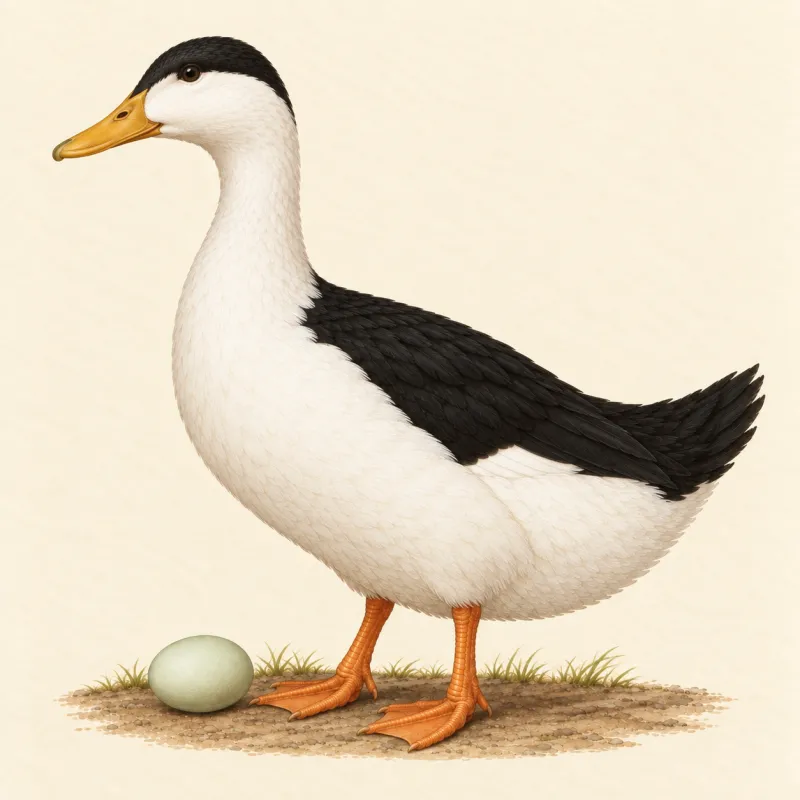
A black and white light duck from the 1920s: hardy, long-lived, and wearing its adult markings from hatch day.
Item specifics: Magpie
- Egg colour
- White, green or blue
- Eggs a year
- 180 (BWA) to 220-290 (Livestock Conservancy)
- Days to hatch
- 28 (The Livestock Conservancy says about a week less)
- Size
- Light; about 2.0-2.7 kg (4.5-6 lb)
- From
- Britain (Wales and Yorkshire), early 1920s
- Temperament
- Active; can be highly strung, friendly if handled young
- UK status
- RBST priority breed (2026-27 watchlist)
Why keepers love it: Magpie
The Magpie was developed in the years after the First World War by the Reverend Gower Williams and Oliver Drake, and first standardised in 1926. The pattern had a practical purpose: a white breast shows no dark stubs when plucked. For the show bench it is exacting, with a coloured cap, a heart-shaped patch across the back and a coloured tail on a white bird, in black, blue, dun or chocolate. A good utility strain could lay 180 eggs a year, and large ones.
Hatching: Magpie
Magpie ducklings hatch in the pattern they will carry into adulthood. The Livestock Conservancy notes that the markings do not change as the birds grow, so well-marked ducklings can be picked out early, and that breeding good show specimens is a challenge because the colour genetics are complex. Eggs may be white, green or blue. Cornell gives about 28 days for mallard-derived ducks, though The Livestock Conservancy says Magpie eggs hatch, on average, a week sooner.
Keeping: Magpie
Magpies are active foragers that eagerly hunt slugs, snails and insects, and the British Waterfowl Association calls them very hardy and long-lived. They cannot fly far but can clear a two to three-foot wall if startled. The Livestock Conservancy finds them highly strung but friendly if handled young, suggests no more than one drake to five ducks, and rates the breed a good one for beginners.
Checked against: British Waterfowl Association, The Poultry Club of Great Britain, Rare Breeds Survival Trust (Magpie, Watchlist: ducks, Watchlist), The Livestock Conservancy, Cornell University Duck Research Laboratory.
Look for Magpie duck hatching eggs on Broody Back to the ten ducks
Hatching duck eggs: the basics
Eggs from mallard-derived ducks, which is every breed here except one, hatch in about 28 days. The Muscovy is a separate species and takes about 35. The British Waterfowl Association gives 37.4°C and 55% humidity for incubation, rising to 60-70% for the hatch; Cornell University's duck laboratory sets 37.5°C and 55%.
For eggs under a broody hen, the association adds that a light spray of tepid water at chipping may help in dry weather. For the full routine, see the guide to hatching eggs in an incubator on our sister site.
Questions about ducks
How long do duck eggs take to hatch?
Duck eggs take about 28 days to hatch for every breed here except the Muscovy, a separate species, whose eggs take about 35.
Which ducks lay the most eggs?
The Khaki Campbell lays the most: some utility strains lay over 300 eggs a year. Welsh Harlequins are quoted at 240 to 330 and good laying strains of Indian Runner at over 250, though exhibition-bred Runners often disappoint.
Which duck lays black eggs?
The Cayuga lays black eggs. Its first eggs of the season carry a dark coat that wipes off to show a green shell, and the colour fades towards white as the season goes on.
Which ducks are quiet?
Muscovies are the quiet ones: the drake's call is low and breathy and the duck's is a soft trill. The Livestock Conservancy calls the Cayuga a quiet breed, and the Welsh Harlequin is one of the quieter ducks. Call ducks are the opposite: the British Waterfowl Association advises against keeping female Calls where there are close neighbours.
Do ducks need a pond?
Ducks do not need a pond, but all waterfowl need water deep enough to immerse the whole head. Indian Runners, for example, do not strictly need swimming water, though they enjoy it.
How we chose these ten
Ten ducks a UK keeper is likely to meet at shows, in gardens and on smallholdings. The choice is ours and nobody has measured it. Every figure was checked against the sources listed with each entry, and where they disagree we give the range. Each plate shows one bird with an egg of the colour the breed lays, even where the bird drawn is the male.
The plates are illustrations, not photographs. We made them with an AI image generator and checked each one against the breed's description, but a drawing is no substitute for seeing the birds, so ask a seller for photos of their own flock.
More from the breed book
Sources
Each entry lists the pages its facts were checked against. For the chapter as a whole: British Waterfowl Association: Domestic ducks, Cornell University Duck Research Laboratory: Hatching duck eggs, Rare Breeds Survival Trust: Watchlist, Cornell University Duck Research Laboratory: Domestic Ducks, Animal Diversity Web, University of Michigan Museum of Zoology: Cairina moschata (Muscovy duck), British Waterfowl Association: Incubation.
Spotted something out of date? Email hello@broodyeggs.co.uk.