Top 10 peacock breeds and colours
People search for peacock breeds, but strictly the birds are peafowl, and there are only three species. Almost everything a breeder calls a breed is a colour or pattern of one of them, the Indian peafowl. Here are ten, with the eggs, the hatching and the noise set out plainly.
Indian peafowl of every colour lay light brown eggs, 3 to 12 in a clutch, that take 27 to 30 days. The colours are all one bird, so they share the India Blue's size: cocks 3.8 to 6 kg, hens 2.8 to 4 kg.
| Variety | Looks like | How it breeds |
|---|---|---|
| India Blue | Blue neck, barred wings, eyed green train | The wild colour |
| White | All white, with train eyes still visible | Breeds true |
| Black Shoulder | Plain black wings; hens pale cream | Recessive; breeds true |
| Pied | Its colour splashed with white | Never true: whites, pieds and dark pieds, 1:2:1 |
| Silver Pied | Mostly white, colour at the neck | Needs the white-eye gene |
| Cameo | Soft browns, no shimmer | Sex-linked: father to daughter |
| Purple | Deep blue that shows purple in sun | Sex-linked, like Cameo |
| Buford Bronze | Deep bronze from crest to train | A single gene, not sex-linked |
| Spalding | Taller, between Indian and Green | Fertile hybrid of the two species |
| Java Green | Green and gold scaled neck, tall crest | A separate species |
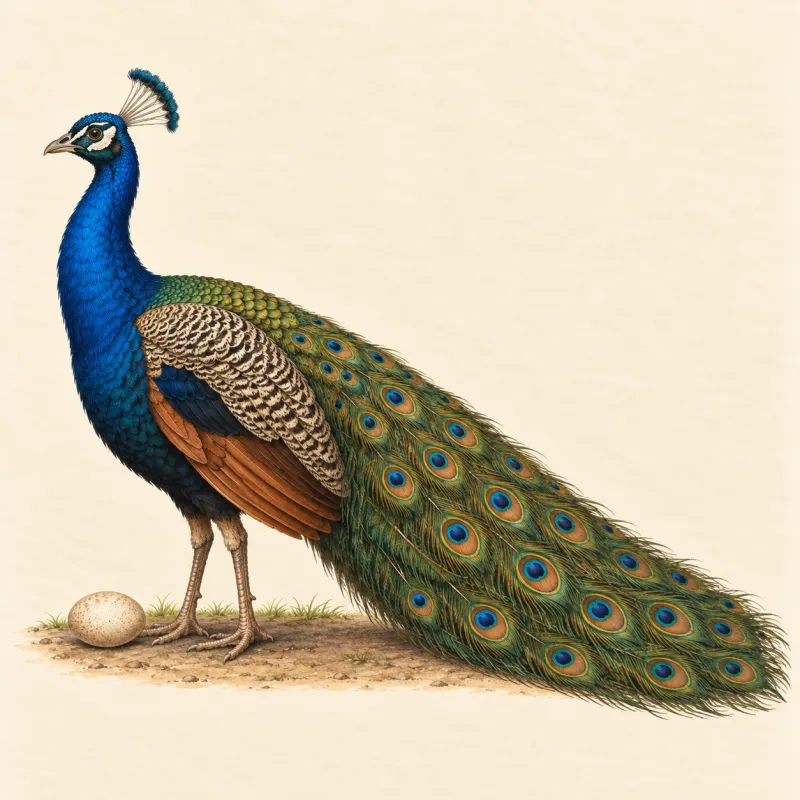
1 India Blue
The wild-type peacock: blue neck, eyed train, a call that carries. The colour mutations all come from it.
Item specifics: India Blue
- Looks like
- Blue neck, barred wings, eyed green train
- How it breeds
- The wild colour
- Egg colour
- Light brown
- Eggs
- One clutch of 3-12; up to 30 if eggs are collected
- Days to hatch
- 27-30 (about 28)
- Size
- Cocks 3.8-6 kg, hens 2.8-4 kg; a cock in full train can pass 2 m in length
- From
- Indian subcontinent
- Temperament
- Alert and wary but tolerant of people; very loud in the breeding season
- UK status
- Familiar ornamental; naturalised non-native in the UK (BTO); IUCN Least Concern
What sets it apart: India Blue
This is the bird most people picture. The cock has a metallic blue head and neck and a train whose eyes have a dark blue centre ringed with blue-green and copper, fanned into a semicircle about two metres wide. The hen is brown with a metallic green lower neck. India Blues are by far the commonest peafowl in captivity, the peacock of British stately homes, and 222 of the 225 varieties on the United Peafowl Association's list are forms or hybrids of this species.
Hatching: India Blue
Peahens normally start laying at two or three years old, an egg every other day from April, in a scrape on the ground. The light brown eggs are about the size of a turkey's and take 27 to 30 days. Chicks hatch brownish buff with darker wing markings and can fly within a week or two, so the brooder must have a lid.
Keeping: India Blue
The noise is real. Cocks call loudly at dawn and late evening from early spring to early autumn, and one English council calls peacocks unsuitable as pets in residential areas. They wander, roost in trees and on roofs, dig up flowerbeds and attack their reflection in cars. Breeding pens should be covered, at least 1.8 m tall (a second guide says 2.1 m) and 3 m wide. In England and Wales keepers must register their birds.
Checked against: United Peafowl Association (Peafowl: Family Phasianidae, Nomenclature of the Peacock, History of Peafowl in Captivity, UPA Approved Variety List), BirdLife International, British Trust for Ornithology, Animal Diversity Web, University of Michigan Museum of Zoology, North Northamptonshire Council, Backyard Poultry magazine, San Diego Zoo Wildlife Alliance, Borough Council of King's Lynn and West Norfolk, Indiana State Poultry Association, GOV.UK, Bulletin of the British Ornithologists' Club.
Look for India Blue peafowl hatching eggs on Broody Back to the ten peafowl
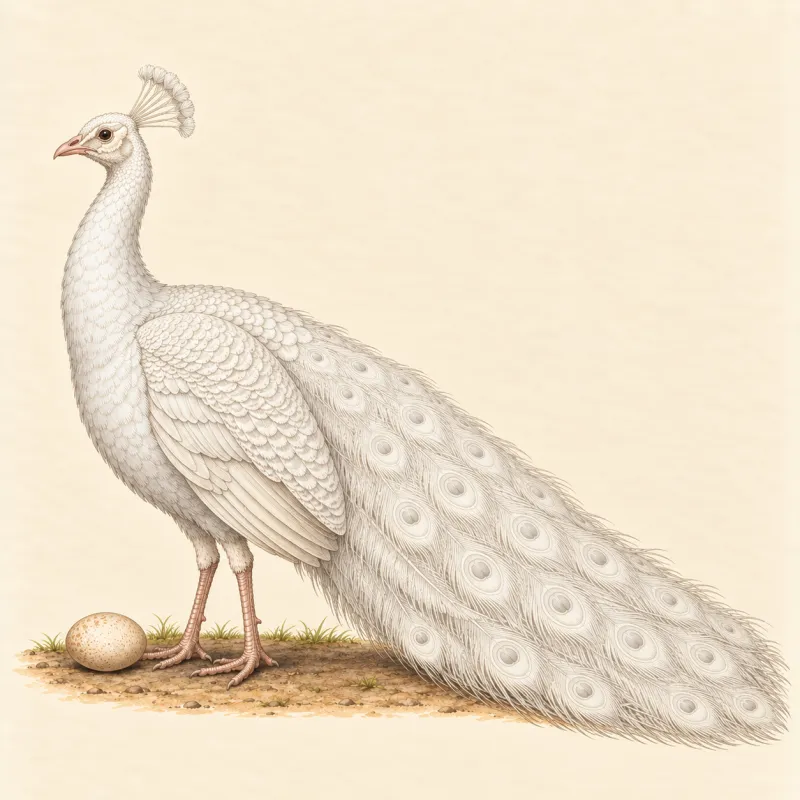
2 White
An all-white Indian peafowl, leucistic rather than albino, whose train eyes still show white on white.
Item specifics: White
- Looks like
- All white, with train eyes still visible
- How it breeds
- Breeds true
- Egg colour
- Light brown
- Days to hatch
- 27-30
- From
- Captive colour mutation of the Indian peafowl, known for at least 150 years
- Temperament
- As India Blue: wary, and very loud in the breeding season
What sets it apart: White
A White cock in display is the whole peacock performance in one colour. Every feather is white, yet the eyes of the train are still visible. It is not an albino: the feathers have no pigment cells, but the eyes keep their melanin and stay dark. Darwin was writing about white peafowl in 1868, and United Peafowl Association writers call it the first colour mutation to appear. A 2025 genome study traced it to a single mutation in the EDNRB2 gene.
Hatching: White
White mated to White breeds true, so every chick is white. They hatch light yellow and feather up white, where an India Blue chick is brownish buff. The chicks are difficult to sex by eye, and United Peafowl Association writers say blood tests are the only sure way. Incubation is the usual 27 to 30 days.
Keeping: White
Care is the same as for an India Blue, noise included. White hides whatever pattern a bird carries, so it can be wild pattern or black shoulder underneath without showing it. Set roosts 1.2 to 1.5 m (four to five feet) up and use flat boards: a United Peafowl Association article warns that toes gripping a round perch can be frostbitten in extreme cold.
Checked against: GigaScience (2025), Journal of Heredity (1993), Online Mendelian Inheritance in Animals, University of Sydney, United Peafowl Association (UPA Approved Variety List, History of Peafowl in Captivity, The peafowl family), Backyard Poultry magazine, GigaScience (2022), Animal Diversity Web, University of Michigan Museum of Zoology, North Northamptonshire Council, Indiana State Poultry Association, San Diego Zoo Wildlife Alliance.
Look for White peafowl hatching eggs on Broody Back to the ten peafowl
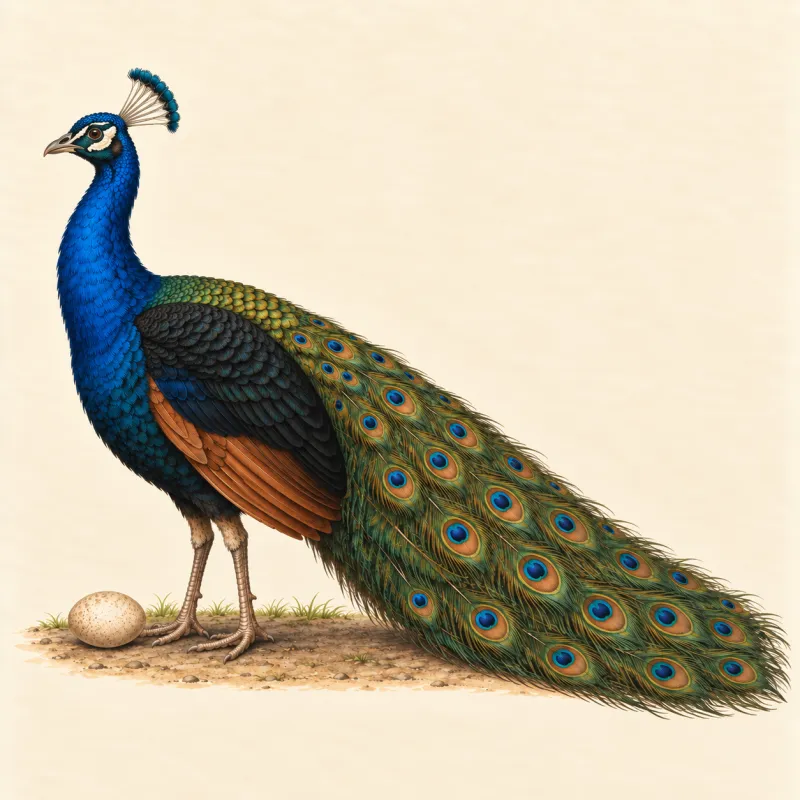
3 Black Shoulder
The pattern Victorian ornithologists took for a new species: black-winged cocks, pale cream hens.
Item specifics: Black Shoulder
- Looks like
- Plain black wings; hens pale cream
- How it breeds
- Recessive; breeds true
- Egg colour
- Light brown
- Days to hatch
- 27-30
- From
- Mutation of the Indian peafowl, seen in British flocks in the 1800s
- Temperament
- As India Blue: wary, and very loud in the breeding season
What sets it apart: Black Shoulder
The cock's wings and shoulders are blackish and plain where an India Blue's are barred, and the rest of him is hardly changed. The hen is the surprise: pale cream with dark mottling. In 1860 Philip Sclater, for 42 years secretary of the Zoological Society of London, named it a separate species, Pavo nigripennis. Darwin gathered seven well authenticated cases of such birds appearing suddenly in British flocks of common peafowl, and showed it was a variety.
Hatching: Black Shoulder
The pattern is recessive. Two Black Shoulders produce only Black Shoulder chicks, and two normal-looking birds can throw one if both carry the gene. Chicks hatch in very pale cream down and feather up white with spots. Cocks and hens look the same at first, and the young cocks start to darken after several months. A 2026 preprint maps the pattern to the MC1R gene.
Keeping: Black Shoulder
In every practical respect this is an Indian peafowl, with the same loud calling and the same need for height and space. One cock runs with four or five hens and turns territorial and combative in the breeding season. Because black shoulder is a pattern and not a colour, breeders have put it onto every colour, Cameo and Purple included.
Checked against: Bulletin of the British Ornithologists' Club, United Peafowl Association (UPA Approved Variety List, The peafowl family), Backyard Poultry magazine, bioRxiv, Borough Council of King's Lynn and West Norfolk, Animal Diversity Web, University of Michigan Museum of Zoology, Indiana State Poultry Association, San Diego Zoo Wildlife Alliance.
Look for Black Shoulder peafowl hatching eggs on Broody Back to the ten peafowl
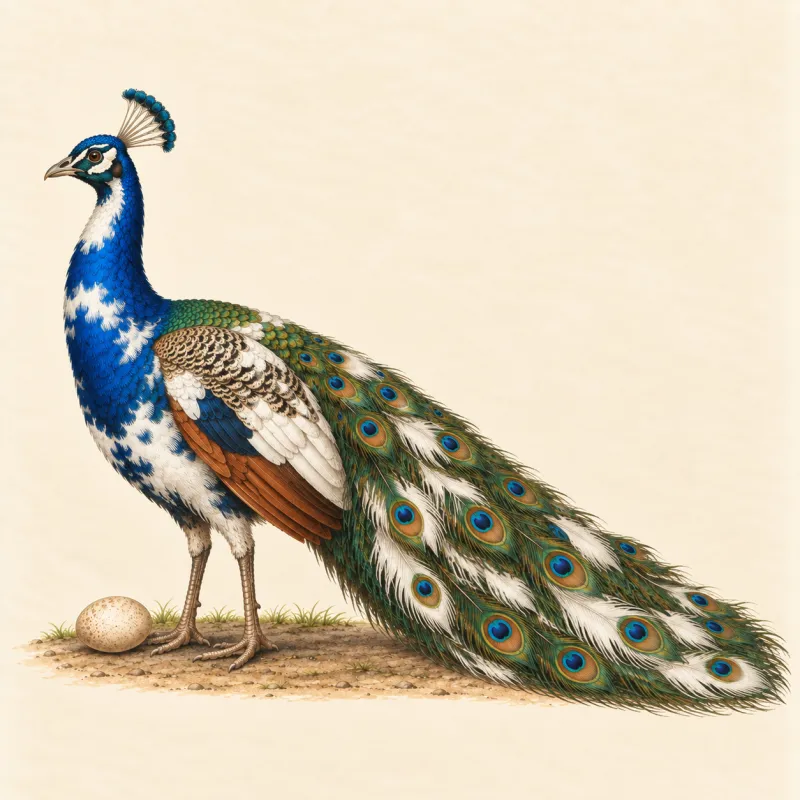
4 Pied
A coloured peafowl splashed with white, in a pattern that never breeds true.
Item specifics: Pied
- Looks like
- Its colour splashed with white
- How it breeds
- Never true: whites, pieds and dark pieds, 1:2:1
- Egg colour
- Light brown
- Days to hatch
- 27-30
- From
- Pattern of the Indian peafowl, seen in Dutch paintings of the 1600s
- Temperament
- As India Blue: wary, and very loud in the breeding season
What sets it apart: Pied
A Pied bird carries its normal colour with some feathers replaced by white, anything from one or two to a great many. United Peafowl Association writers put the ideal at 30 to 50 per cent white. The pattern is old. Many of the peafowl in Dutch farmyard paintings of the 1600s are pied, and Darwin reported pied birds in 1868. In a 2025 genome study the pied bird carried one copy of the mutation that makes a peafowl white.
Hatching: Pied
Pied mated to Pied does not breed true. A 1993 Journal of Heredity study found the chicks come as whites, pieds and dark pieds in a 1:2:1 ratio, so on average only half a hatch is pied. Dark pieds are coloured birds that carry the pied gene, and the same study gives the shortcut: dark pieds bred to whites produce all pieds. A small hatch may not follow the ratio.
Keeping: Pied
Housing, feeding and noise are as for an India Blue. The United Peafowl Association's care article feeds breeders a game bird layer ration in the breeding season and a maintenance ration before and after it. The Association's list of do's and don'ts is blunt about crowding: do not overcrowd peafowl in pens with each other or with other types of poultry.
Checked against: Journal of Heredity (1993), GigaScience (2025), Bulletin of the British Ornithologists' Club, United Peafowl Association (UPA Approved Variety List, The peafowl family, Keeping Peafowl: Do's and Don'ts), Backyard Poultry magazine, North Northamptonshire Council, Animal Diversity Web, University of Michigan Museum of Zoology, Indiana State Poultry Association, San Diego Zoo Wildlife Alliance.
Look for Pied peafowl hatching eggs on Broody Back to the ten peafowl
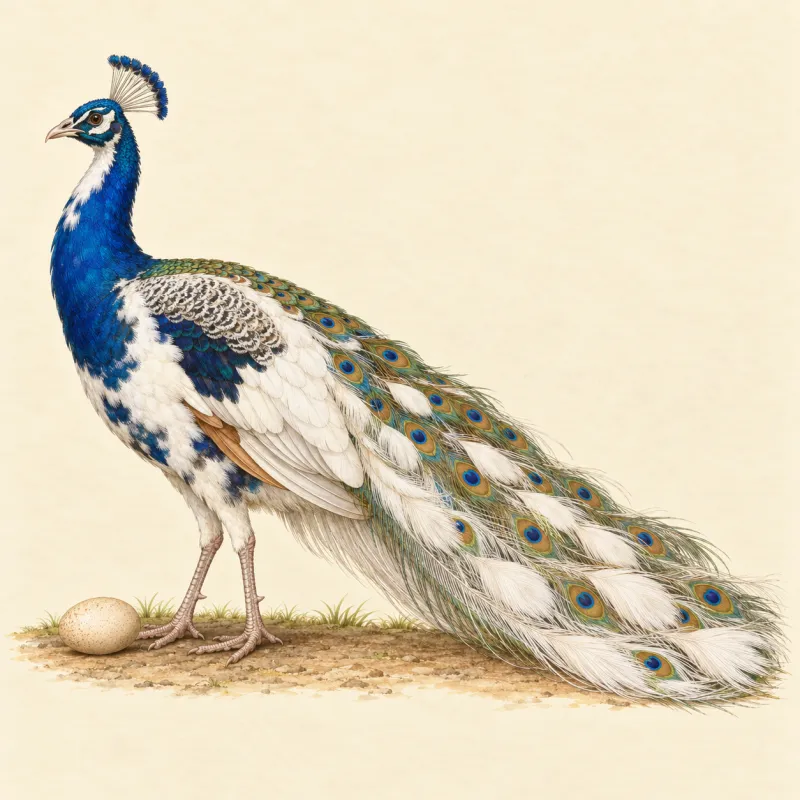
5 Silver Pied
A mostly white peafowl with colour at the neck and a back that turns silvery with age.
Item specifics: Silver Pied
- Looks like
- Mostly white, colour at the neck
- How it breeds
- Needs the white-eye gene
- Egg colour
- Light brown
- Days to hatch
- 27-30
- From
- Captive-bred pattern of the Indian peafowl
- Temperament
- As India Blue: wary, and very loud in the breeding season
What sets it apart: Silver Pied
Silver Pied turns the pied idea round: a white peafowl with only 10 to 20 per cent coloured feathers, usually on the neck, the upper breast and parts of the tail. Cocks take on a more silvery colour on the back as they age. The pattern must carry the white-eye gene, which puts white into the eyes of the train. The United Peafowl Association lists a Silver Pied version of its colours, from India Blue to Cameo and Purple.
Hatching: Silver Pied
Silver Pied chicks hatch white, usually with a dark spot on the back of the head, the neck or the back. Hens grow into white birds marked with silver grey. Cocks can end up with an all-white train, because the white masks the white-eye pattern. Incubation is the usual 27 to 30 days for peafowl eggs.
Keeping: Silver Pied
Keep it as any other Indian peafowl. New birds need penning before they are let out, or they leave: one Norfolk council advises a minimum of six weeks and the United Peafowl Association several months. Foxes are the British risk. The same council notes that many peahens are taken by foxes while sitting on their eggs.
Checked against: United Peafowl Association (UPA Approved Variety List, The peafowl family, Keeping Peafowl: Do's and Don'ts), Backyard Poultry magazine, Borough Council of King's Lynn and West Norfolk, Wikipedia, Animal Diversity Web, University of Michigan Museum of Zoology, Indiana State Poultry Association, San Diego Zoo Wildlife Alliance.
Look for Silver Pied peafowl hatching eggs on Broody Back to the ten peafowl
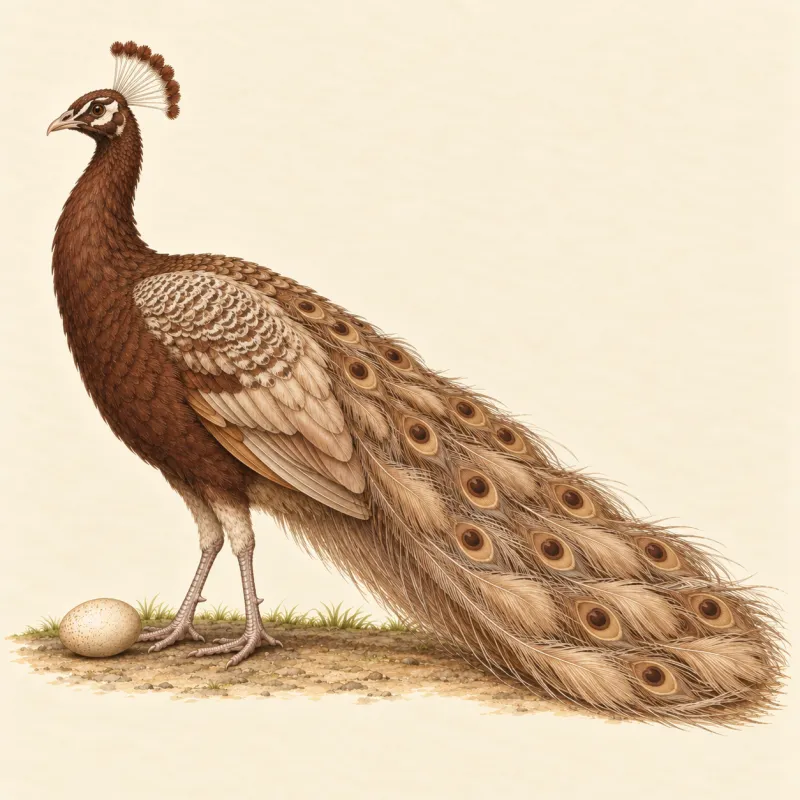
6 Cameo
A soft brown peafowl with no shimmer, whose colour passes from father to daughter.
Item specifics: Cameo
- Looks like
- Soft browns, no shimmer
- How it breeds
- Sex-linked: father to daughter
- Egg colour
- Light brown
- Days to hatch
- 27-30
- From
- Maine, USA: the original Cameo was a hen hatched by Oscar Mulloy
- Temperament
- As India Blue: wary, and very loud in the breeding season
What sets it apart: Cameo
Cameo trades the blues and greens for browns. The cock's crest, head, neck and breast are chocolate brown, his wings light tan barred with brown, and his train light brown with the eyes still easy to see. There is no iridescence: a 2026 preprint found that the ordered feather structure behind a peacock's shimmer has collapsed in Cameo. The original bird was a hen hatched by Oscar Mulloy of Maine.
Hatching: Cameo
Cameo is sex-linked, which makes pairings predictable. A Cameo cock on hens of another colour gives Cameo daughters, and sons that carry the colour without showing it. One United Peafowl Association history page has the sexes the other way round; the published genetics and Backyard Poultry's guide give them as here. A Cameo hen mated to a cock of another colour has no Cameo chicks at all. Cameo to Cameo breeds true, and the chicks hatch creamy tan.
Keeping: Cameo
A Cameo is kept exactly like an India Blue and is just as loud. Patience comes with any peacock: he does not carry a full train until he is three, it reaches its best at about five or six, and by the United Peafowl Association's account he moults the whole train in late summer, which is when the breeding season ends.
Checked against: United Peafowl Association (UPA Approved Variety List, History of Peafowl in Captivity, The peafowl family), Backyard Poultry magazine, bioRxiv, Journal of Heredity (1991), Wikipedia, San Diego Zoo Wildlife Alliance, Animal Diversity Web, University of Michigan Museum of Zoology, Indiana State Poultry Association.
Look for Cameo peafowl hatching eggs on Broody Back to the ten peafowl
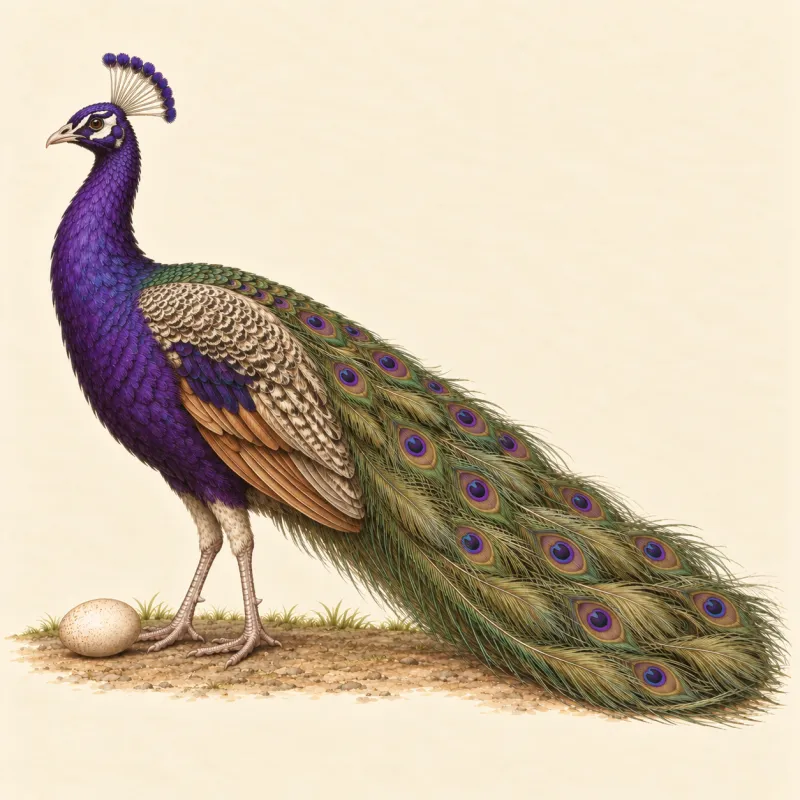
7 Purple
A deeper blue than India Blue until the sun catches it, then neck and train eyes show purple.
Item specifics: Purple
- Looks like
- Deep blue that shows purple in sun
- How it breeds
- Sex-linked, like Cameo
- Egg colour
- Light brown
- Days to hatch
- 27-30
- From
- Captive colour mutation of the Indian peafowl
- Temperament
- As India Blue: wary, and very loud in the breeding season
What sets it apart: Purple
Out of the sun a Purple cock reads as a deeper blue than an India Blue. In sunshine the red and blue tones in the feathers show as a definite purple, and the first wide band of colour around the dark centre of each train eye is purple too. Unlike Cameo it keeps its iridescence: a 2026 preprint found the feather structure intact, with much less melanin in it, and linked the colour to the TYRP1 gene on the Z chromosome.
Hatching: Purple
Purple is sex-linked in the same way as Cameo: a Purple cock on hens of another colour gives Purple daughters, and sons that carry it unseen. The chicks look much like India Blue chicks, so the colour is not obvious in the brooder. Purple hens resemble India Blue hens, with a definite purple hue to the neck feathers.
Keeping: Purple
Purple needs nothing that an India Blue does not. It is a long commitment: San Diego Zoo gives peafowl a life span of 15 to 20 years. The birds are hardy. The University of Michigan's species account says they survive winters in southern Britain with only a simple shelter, but do less well where it is both damp and cold.
Checked against: United Peafowl Association (UPA Approved Variety List, The peafowl family), Backyard Poultry magazine, bioRxiv, Wikipedia, San Diego Zoo Wildlife Alliance, Animal Diversity Web, University of Michigan Museum of Zoology, Indiana State Poultry Association.
Look for Purple peafowl hatching eggs on Broody Back to the ten peafowl
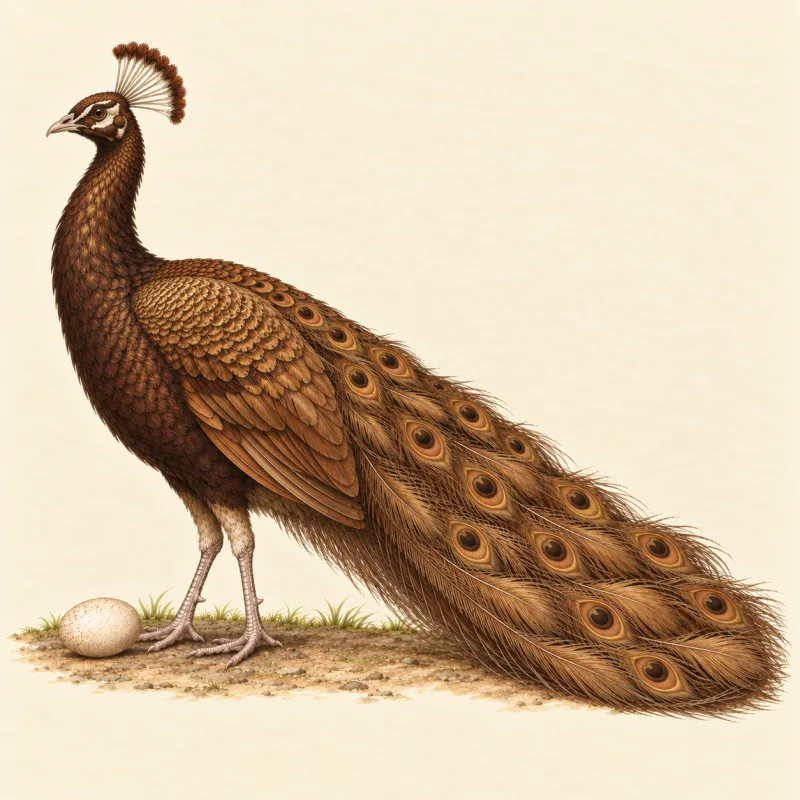
8 Buford Bronze
A rich bronze peafowl from crest to train, named for the man who first worked with it.
Item specifics: Buford Bronze
- Looks like
- Deep bronze from crest to train
- How it breeds
- A single gene, not sex-linked
- Egg colour
- Light brown
- Days to hatch
- 27-30
- From
- Captive colour mutation, first worked with by the breeder Buford Abbott
- Temperament
- As India Blue: wary, and very loud in the breeding season
What sets it apart: Buford Bronze
The whole cock is a rich, deep bronze, slightly lighter on the coverts, and each eye of the train has a black centre finished in shades of bronze. Hens are brown with darker bronze through the neck. The name records the history: Buford Abbott first discovered the colour and started working with it, and after his death another breeder bought the birds, continued the work and suggested the name.
Hatching: Buford Bronze
Bronze chicks hatch dark brown, where an India Blue chick is brownish buff. Bronze is not one of the sex-linked colours, so it does not pass differently to sons and daughters the way Cameo and Purple do. A 2026 preprint groups it with the single-gene colour mutations and describes the adult plumage as weakly iridescent.
Keeping: Buford Bronze
Daily care matches the India Blue. Peachicks of any colour need heat at first: the United Peafowl Association's rule of thumb is a brooder at 95°F (35°C), lowered by 5°F for every week of age, and a 28 to 30 per cent game bird starter for the first month. It also advises against mixing chicks more than two weeks apart in age.
Checked against: United Peafowl Association (UPA Approved Variety List, Keeping Peafowl: Do's and Don'ts, The peafowl family), Backyard Poultry magazine, bioRxiv, Wikipedia, Animal Diversity Web, University of Michigan Museum of Zoology, Indiana State Poultry Association, San Diego Zoo Wildlife Alliance.
Look for Buford Bronze peafowl hatching eggs on Broody Back to the ten peafowl
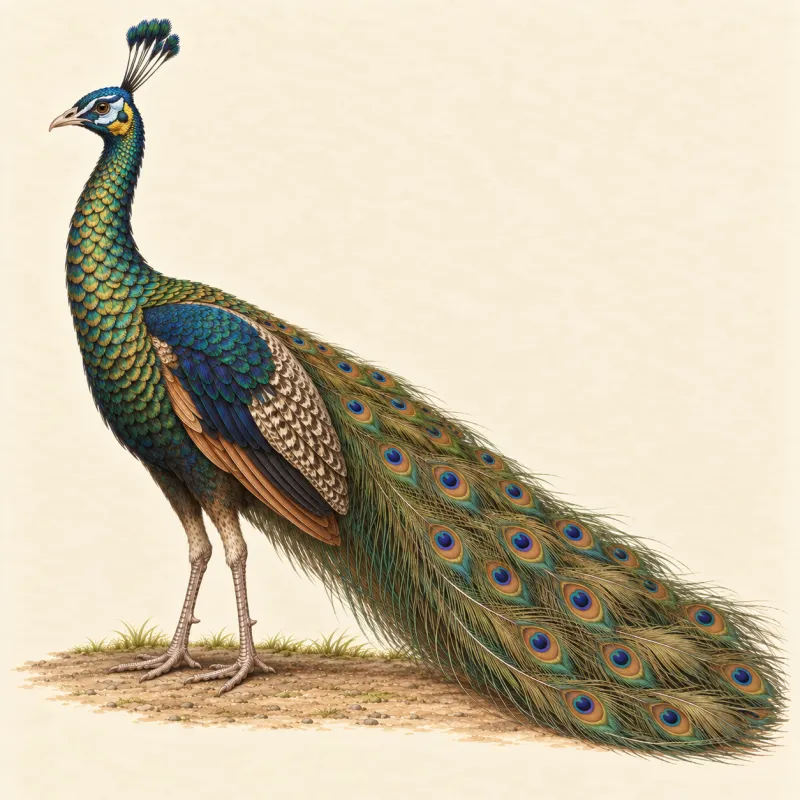
9 Spalding
The fertile hybrid of Indian and Green peafowl: taller than a blue and intermediate in looks.
Item specifics: Spalding
- Looks like
- Taller, between Indian and Green
- How it breeds
- Fertile hybrid of the two species
- Egg colour
- Not recorded for the hybrid
- Days to hatch
- 27-30 (general peafowl figure)
- Size
- Taller than an India Blue
- From
- Hybrid of Indian and Green peafowl, named after the Spaldings of California
What sets it apart: Spalding
A Spalding is any Indian peafowl colour crossed with a Green. The name comes from California: Backyard Poultry credits a Mrs Spalding as the first person to document the cross, and other accounts name Keith Spalding. The hybrids are fertile and intermediate between the parents: first-cross cocks are told most reliably by the shape of the bare facial skin and the colour of the wings. The Green blood gives a taller bird. The United Peafowl Association lists Spalding forms of every colour, 111 varieties in all.
Hatching: Spalding
The hybrids are fertile, so a Spalding can be bred to another Spalding or back to either parent species. Bred back to Green again, the young show more and more Green characteristics. The United Peafowl Association's 27 to 30 days for peafowl eggs is the incubation figure to work to.
Keeping: Spalding
Honesty about parentage matters with this bird. A 2025 genome study found three hybrid Green peafowl in zoo collections, and its authors want birds tested for purity before any release into the wild. Through backcrossing some hybrids become almost indistinguishable from pure Greens, so keep written records and never run Spaldings with pure Green breeding stock.
Checked against: The Wilson Journal of Ornithology, GigaScience (2025), United Peafowl Association (UPA Approved Variety List, The peafowl family), Backyard Poultry magazine, Wikipedia (Indian peafowl, Green peafowl), The IUCN Red List of Threatened Species.
Look for Spalding peafowl hatching eggs on Broody Back to the ten peafowl
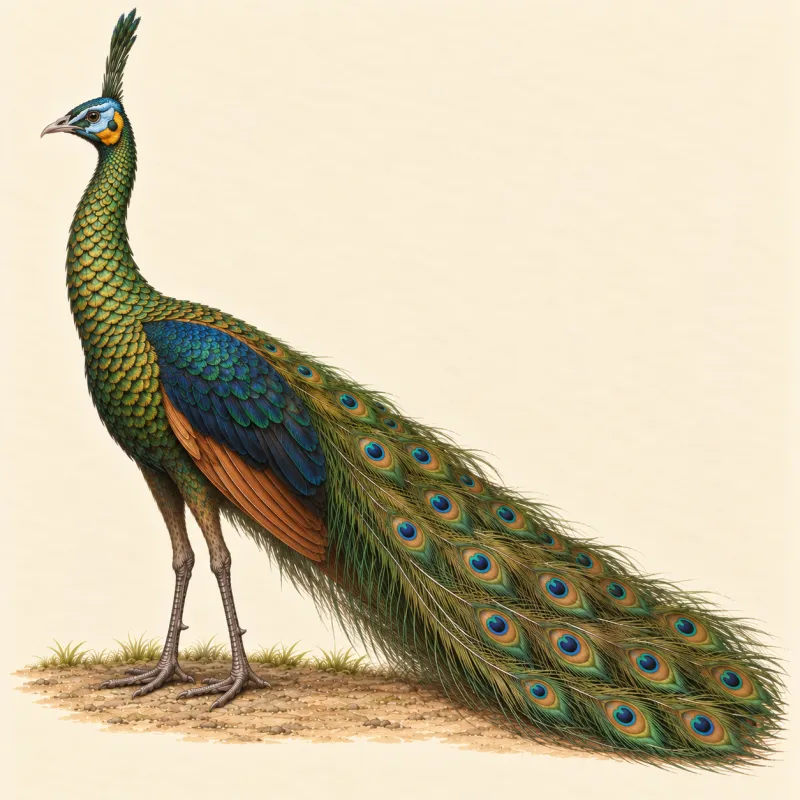
10 Java Green
The other peafowl species: longer-legged, scaled in green and gold, and Endangered in the wild.
Item specifics: Java Green
- Looks like
- Green and gold scaled neck, tall crest
- How it breeds
- A separate species
- Egg colour
- Light green or tan (San Diego Zoo, describing both peafowl species)
- Eggs
- One clutch of 3-6 (some sources say up to 8)
- Days to hatch
- 26-30
- Size
- Larger than the Indian peafowl; cocks 1.8 to 3 m long with the train
- From
- South-east Asia; the Javan subspecies comes from Java, Indonesia
- Temperament
- Reputed flighty and unfriendly; less tolerant of people than the Indian peafowl
- UK status
- IUCN Endangered; CITES Appendix II
What sets it apart: Java Green
The Green peafowl is a separate species, Pavo muticus, not a colour of the Indian bird. It is longer-legged and more streamlined, with a tall, tight crest in place of a fan, and neck feathers laced in green-gold so heavily that they look like scales. The hen is only slightly less colourful than the cock. Java Green is the keeper's name: strictly the Javan bird is one of three subspecies on the United Peafowl Association's list.
Hatching: Java Green
Green peachicks are larger and longer-legged than Indian chicks and hatch a dark charcoal brown. Young birds are harder to sex, and United Peafowl Association writers recommend a laboratory test. A clutch is three to eight eggs, and peafowl eggs take 26 to 30 days. Indian and Green birds kept together regularly produce fertile hybrids, so pure stock has to be penned apart.
Keeping: Java Green
Greens are the difficult option. The United Peafowl Association's history says they cannot withstand low temperature extremes and sometimes have a reputation for being flighty and unfriendly. In the wild the species is Endangered: BirdLife's estimate is 10,000 to 19,999 mature birds and falling, after intense habitat loss and hunting. It is listed on CITES Appendix II. Anyone keeping Greens is holding a conservation species, not just a peacock.
Checked against: BirdLife International, The IUCN Red List of Threatened Species, Species+ (UNEP-WCMC and the CITES Secretariat), United Peafowl Association (History of Peafowl in Captivity, Nomenclature of the Peacock, UPA Approved Variety List, The peafowl family), Backyard Poultry magazine, GigaScience (2025), Wikipedia, San Diego Zoo Wildlife Alliance, The Wilson Journal of Ornithology, Animal Diversity Web, University of Michigan Museum of Zoology.
Look for Java Green peafowl hatching eggs on Broody Back to the ten peafowl
Hatching peafowl eggs: the basics
Peafowl eggs hatch in 27 to 30 days. The United Peafowl Association's incubation guide uses 99 to 100°F (37.2 to 37.8°C) and 60% humidity. Peachicks need heat from the start: the association's rule of thumb is a brooder at 95°F (35°C), lowered by 5°F for each week of age, with a 28 to 30 per cent game bird starter feed for the first month.
This is a slow hobby. A peahen normally starts laying at two or three years old, and a cock does not carry a full train until he is three. In England and Wales anyone keeping peafowl must register their birds, as with any other captive birds kept outdoors.
Questions about peafowl
How many breeds of peacock are there?
There are three species of peafowl, and what breeders call breeds are colours and patterns. The United Peafowl Association's list has 225 varieties, and 222 of them are forms or hybrids of the Indian peafowl.
How long do peafowl eggs take to hatch?
Peafowl eggs take 27 to 30 days to hatch.
Are white peacocks albino?
No, white peacocks are not albino. A White peafowl's feathers have no pigment cells, but its eyes keep their melanin and stay dark. White mated to White breeds true, so every chick is white.
How noisy are peacocks?
Peacocks are very noisy in the breeding season. Cocks call loudly at dawn and late evening from early spring to early autumn, and one English council calls peacocks unsuitable as pets in residential areas.
When do peahens start laying?
Peahens normally start laying at two or three years old, an egg every other day from April. A cock does not carry a full train until he is three.
How we chose these ten
The ten are the wild colour of the Indian peafowl, seven colours and patterns bred from it, the Green peafowl, and the hybrid of the two species. The choice is ours and nobody has measured it. Every figure was checked against the sources listed with each entry, and where they disagree we give the range. Each plate shows the peacock, because the colours are named for his plumage, with an egg of the colour peahens lay. The Spalding and Java Green plates have no egg: no source gives a colour for the hybrid, and the only one we found for the Green describes both species at once.
The plates are illustrations, not photographs. We made them with an AI image generator and checked each one against the breed's description, but a drawing is no substitute for seeing the birds, so ask a seller for photos of their own flock.
More from the breed book
Sources
Each entry lists the pages its facts were checked against. For the chapter as a whole: United Peafowl Association: The peafowl family, United Peafowl Association: Artificial incubation of peafowl eggs, BirdLife International: Green peafowl factsheet, GOV.UK: Register as a keeper of less than 50 poultry or other captive birds, Wikipedia: Peafowl, Backyard Poultry magazine: Identifying Peafowl Varieties, by George and Sonja Conner of the United Peafowl Association, United Peafowl Association: History of Peafowl in Captivity, Indiana State Poultry Association: Raising Peafowl, Borough Council of King's Lynn and West Norfolk: Peafowl (Peacocks), San Diego Zoo Wildlife Alliance: Peafowl, United Peafowl Association: Keeping Peafowl: Do's and Don'ts.
Spotted something out of date? Email hello@broodyeggs.co.uk.