Top 10 pigeon breeds for UK fanciers
Pigeons are the one bird in this book you do not hatch in an incubator. A pair lays two eggs, shares the sitting for 17 to 19 days, then feeds the squabs on crop milk. So this chapter is about the birds themselves: ten breeds, from a racer that finds its way home across hundreds of miles to a Jacobin whose hood hides everything but the view ahead.
- Racing Homer
- Fantail
- Birmingham Roller
- Tippler
- King
- Modena
- Archangel
- Frillback
- English Pouter
- Jacobin
| Breed | Kind | Known for | From |
|---|---|---|---|
| Racing Homer | Racing | Flying home from hundreds of miles away | Belgium and England |
| Fantail | Fancy | A fan of thirty or more tail feathers | Probably India |
| Birmingham Roller | Performing flyer | Spinning backwards in flight | Birmingham and the Black Country |
| Tippler | Endurance flyer | Flights of 20 hours and more | East Cheshire |
| King | Table and show | Twice the weight of a racer | United States |
| Modena | Show | A short, round "bird of curves" | Modena, Italy |
| Archangel | Show | A copper body with a metallic sheen | Probably the Dalmatian coast |
| Frillback | Show | Curled feathers | Uncertain |
| English Pouter | Show | A crop blown up like a balloon | England |
| Jacobin | Show | A hood of reversed neck feathers | Usually said to be India |
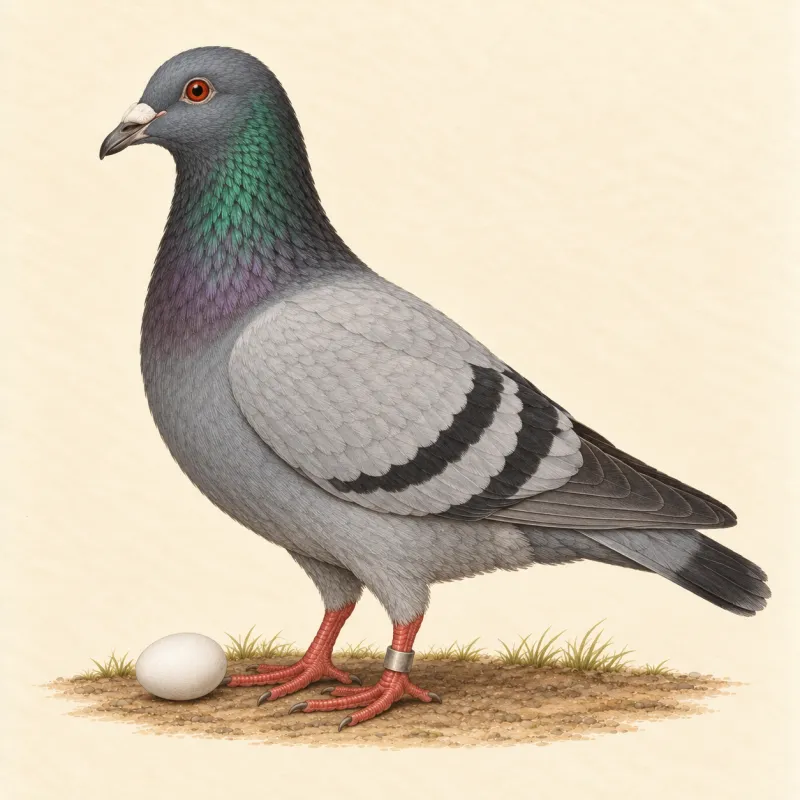
1 Racing Homer
The pigeon that flies home: made in Belgium and England to race back from hundreds of miles away.
Item specifics: Racing Homer
- Egg colour
- White
- Days to hatch
- 17-19
- Size
- Cocks 14-17 oz (400-480 g), hens 13-16 oz (370-450 g)
- From
- Belgium and England, early 1800s
- Temperament
- Tame, used to people and to being handled
- UK status
- The usual first breed for new UK fanciers; the RPRA is the main governing body for racing
Why fanciers love it: Racing Homer
A good racer finds its own loft from hundreds of miles off, steering by the sun, the earth's magnetic field and scent, then by landmarks near home. The breed is only about 200 years old, made in Belgium and England in the early 1800s by crossing several older breeds. Pairs often stay together for life and a well-kept bird can live past twenty. Of the 53 Dickin Medals awarded in the Second World War, 32 went to pigeons.
Breeding: Racing Homer
Lofts pair their birds early in the year. By the US Army's pigeon manual the hen lays two eggs about 44 hours apart, and the pair seldom sit properly until the second is laid, so the squabs hatch within an hour of each other. She sits from late afternoon to mid-morning and the cock takes the day shift, for 17 to 18 days. Both then feed crop milk. A GB ring records the year of breeding.
Keeping: Racing Homer
The RPRA suggests a loft of about 6ft by 6ft and six to ten young birds, settled young because older birds try to return to where they were bred. Some never come home from races. Sparrowhawks attack at lofts and peregrines in training, though studies suggest raptors take a small share. Racers must be vaccinated and keepers registered, and bird flu rules can cap flying at an hour a day.
Checked against: Royal Pigeon Racing Association (Getting started, A beginner's guide, About RPRA, Stray Reporting, Registration of Birds), GOV.UK (Defra and APHA), Current Biology (2013), United States War Department, via Project Gutenberg, Genome Biology and Evolution (2020), Developmental Biology (2017), Small and Backyard Poultry (Extension Foundation), Current Biology (2012), European Journal of Wildlife Research (2021), GOV.UK (Paramyxovirus infection, Register as a keeper of less than 50 poultry or other captive birds), Wikipedia, Animals (2024), Animals (2020).
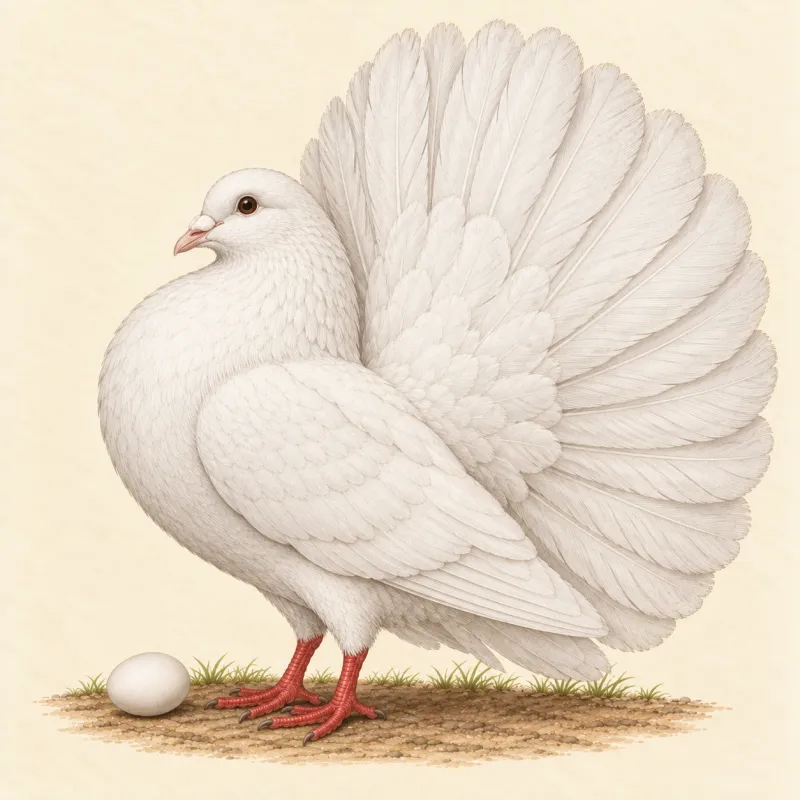
2 Fantail
A short-bodied pigeon carrying thirty or more tail feathers in an upright fan, where most breeds have twelve.
Item specifics: Fantail
- Egg colour
- White
- Days to hatch
- 17-19
- Size
- Short-bodied; NPA ring size B, European (EE) ring 8 mm
- From
- Probably India, where it was recorded before 1600
- Temperament
- Trembles habitually; a weak flyer
- UK status
- Has its own NPA-affiliated breed club, the Fantail Club (inaugurated 1889)
Why fanciers love it: Fantail
Darwin counted 33 tail feathers on one of his own Fantails, against the usual twelve, and noted that in good birds the head touches the tail. They tremble habitually and walk as if their small feet were stiff. The breed was recorded in India before 1600, and geneticists think it began there. The NPA lists Garden Fantails and Indian Fantails separately, under different ring sizes, and the show Fantail has had its own British club since 1889.
Breeding: Fantail
Fantails pair, sit and feed like any pigeon: two eggs, both birds sharing the nest, then crop milk for the squabs. The fan does not travel well in a cross. Darwin found other breeds dominated the Fantail when crossed, and Utah geneticists believe a small number of genes control the size, number and texture of the tail feathers. The breed has seen less outcrossing than many.
Keeping: Fantail
Fantails belong in a loft and fly pen, not at liberty. University of Kentucky extension advice is to confine them, because they are weak flyers that cannot see a predator coming from behind or ahead, and Darwin noted that they fly badly on a windy day. Damp housing risks disease. A genome study found very low genetic diversity in the breed, the mark of a past bottleneck.
Checked against: National Pigeon Association (GB) (Affiliated regional and breed clubs, Authorised sizes and distinguishing marks of rings), Charles Darwin, via Wikisource (The Variation of Animals and Plants under Domestication, chapter V (1868), The Variation of Animals and Plants under Domestication, chapter VI (1868), The Variation of Animals and Plants under Domestication, chapter XIV), Current Biology (2012), Small and Backyard Poultry (Extension Foundation), Genetic Science Learning Center, University of Utah, Charles Darwin, via Darwin Online, Genome Biology and Evolution (2020), Wikipedia (Fantail pigeon, Rock dove), Entente Européenne, published by FESACOCUR, British Trust for Ornithology, PLOS ONE (2012), Developmental Biology (2017).
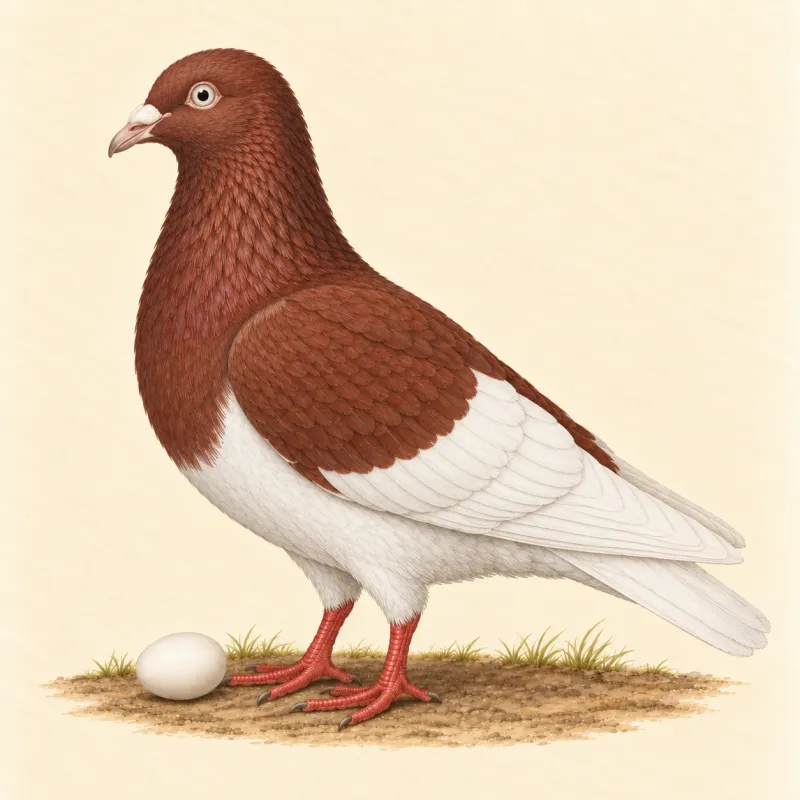
3 Birmingham Roller
A small West Midlands flyer that spins backwards through the air like a ball, then rejoins its kit.
Item specifics: Birmingham Roller
- Egg colour
- White
- Days to hatch
- 17-19
- Size
- Small; NPA ring size A, European (EE) ring 7 mm
- From
- Birmingham and the Black Country, England
- UK status
- Flown and shown; NPA-affiliated Northern Roller Club
Why fanciers love it: Birmingham Roller
Flying tumblers were common in Staffordshire and Worcestershire for two centuries before 1900, and the breeder William Pensom held that the fastest spinners all came from the Black Country. His English birds flew at 200 to 600 feet and rolled 15 to 30 feet. When club contests began around 1921, kits of twenty were judged for twenty minutes. Colour counts for nothing: birds are selected for performance. Tumbling is inherited, and it seems to be rooted in brain chemistry rather than in the shape of the wings or tail.
Breeding: Birmingham Roller
Roller pairs sit in turn on two eggs and feed their squabs crop milk like any pigeon. Utah geneticists say one allele of a single gene is enough to make a pigeon tumble, and that the same allele combined with certain alleles of other genes produces rolling. Fanciers select the youngsters that show the wanted performance and breed closely from them.
Keeping: Birmingham Roller
Rollers are flown as a kit; old Birmingham fanciers kept twenty flying tumblers in a box between daily flights. Deep rollers flown low over rooftops met with casualties, which is why town flyers preferred shorter workers. UK research on racing pigeons found sparrowhawks attack mostly at the loft. Under bird flu rules, pigeons may be limited to one hour's flying a day.
Checked against: National Pigeon Association (GB) (Affiliated regional and breed clubs, Authorised sizes and distinguishing marks of rings), National Birmingham Roller Club, Genetic Science Learning Center, University of Utah, Small and Backyard Poultry (Extension Foundation), Current Biology (2012), Wikipedia (Birmingham Roller, Rock dove), European Journal of Wildlife Research (2021), GOV.UK, Entente Européenne, published by FESACOCUR, British Trust for Ornithology, PLOS ONE (2012), Developmental Biology (2017).
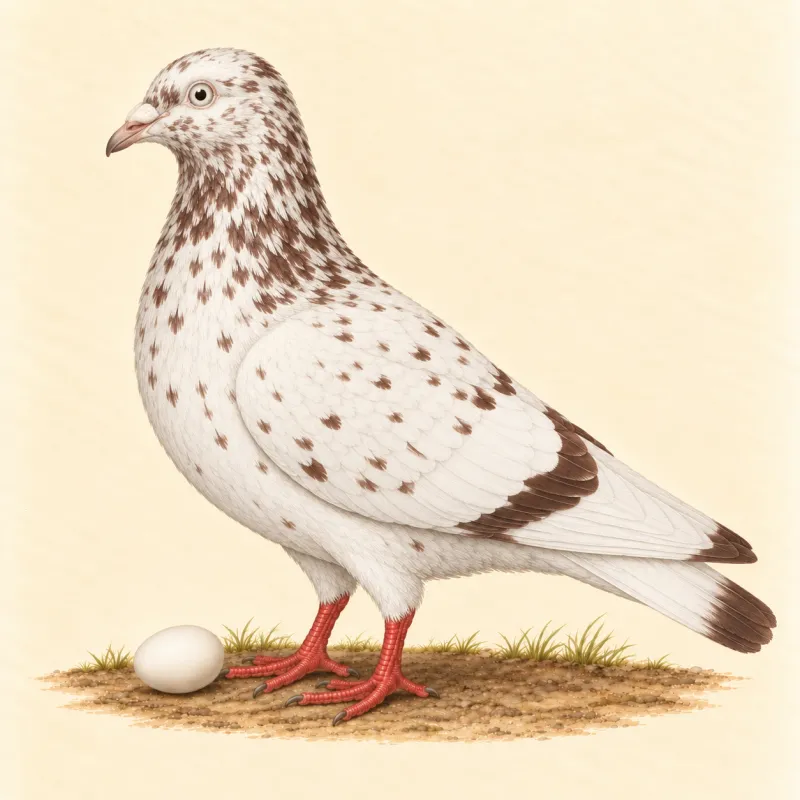
4 Tippler
A Cheshire-bred endurance flyer: kits of three have stayed on the wing for more than 22 hours.
Item specifics: Tippler
- Egg colour
- White
- Days to hatch
- 17-19
- Size
- Medium, similar to a roller; NPA ring size A for show and competition Tipplers, B for exhibition flying Tipplers
- From
- East Cheshire, England, in or before the 1840s
- Temperament
- A bird that loves to fly
- UK status
- Flying, exhibition and show types all have NPA-affiliated clubs
Why fanciers love it: Tippler
The Tippler does not race home or roll. It simply stays up. Fanciers around Congleton and Macclesfield developed it in or before the 1840s, and by 1886 their kits of three were flying twelve or thirteen hours. Twenty hours is now flown regularly in the UK, and Harry Shannon's three yearling hens set the record of 22 hours 5 minutes in Northern Ireland in 1995. Birds are released with dusk in mind and called down by droppers.
Breeding: Tippler
A competition kit needs at least three birds, so flyers try to have three pairs hatch at the same time; nest mates make the better kit. The old rule is to pair best flyer to best flyer, never for colour or body style. Pairs share the sitting and feed crop milk as all pigeons do. Training starts at about four weeks, and losses while settling can be heavy.
Keeping: Tippler
Young Tipplers are kept hungry and keen while they settle, then flown in kits about twice a week. Pale, placid droppers of a non-flying breed call them down. The Canadian National Tippler Union says birds of prey have hit the breed hard in England, since long flights raise the odds of attack. UK clubs include the United Show Tippler Club and the Northern Counties Flying Tippler and Tumbler Society.
Checked against: National Pigeon Association (GB) (Affiliated regional and breed clubs, Authorised sizes and distinguishing marks of rings), Canadian National Tippler Union (The English Flying Tippler, Macclesfield Tipplers (G. Smith, 1886), Breeding the English Flying Tippler), Current Biology (2013), Wikipedia (Tippler, Rock dove), British Trust for Ornithology, PLOS ONE (2012), Developmental Biology (2017).
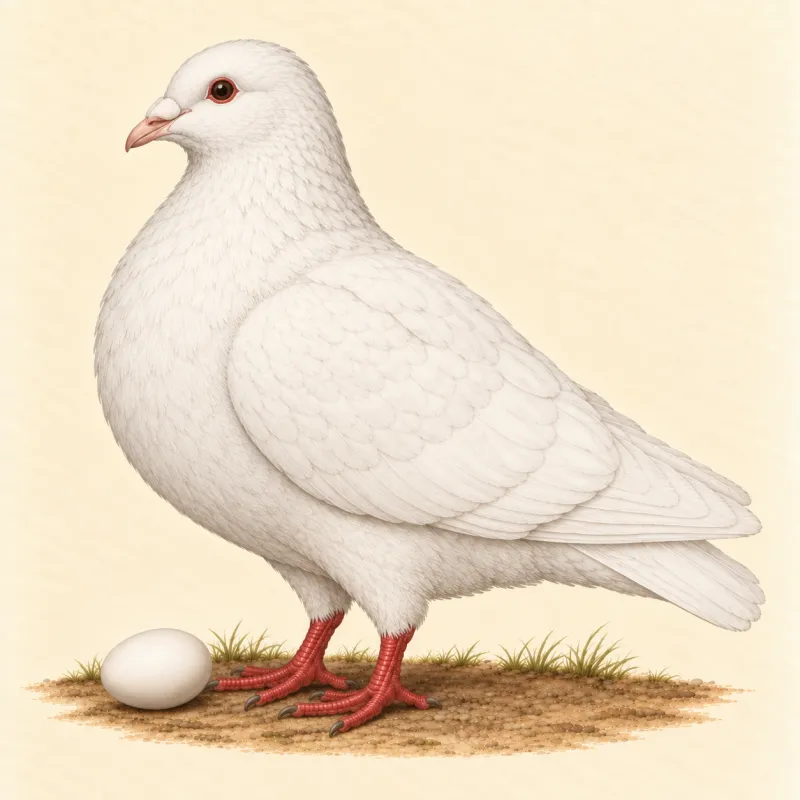
5 King
A big, broad American table pigeon: show birds weigh 30 to 37 oz, twice the weight of a racing pigeon.
Item specifics: King
- Egg colour
- White
- Days to hatch
- 17-19
- Size
- Show birds 30-37 oz (850-1,050 g), 11¾ in tall; NPA ring size E
- From
- United States, around 1900
- UK status
- NPA-affiliated British King Club
Why fanciers love it: King
The King was built in the United States for squab, and it remains one of the two breeds on which American meat-pigeon production is based. It has since become a show bird as well, standing 11¾ inches tall with a short, broad, well-rounded body. Its eggs are bigger than a flying pigeon's, averaging 23.4 g against 19.3 g in one study. White came first; silver, blue, red, yellow, dun and black joined the American standard between 1921 and 1948.
Breeding: King
Squab production rises when each pair has two nests. Once the first eggs hatch, the hen lays two more in the second and sits while the cock feeds the squabs in the first. Ten working pairs rear about eight squabs a month, taken at 26 to 30 days. Extension advice warns that show-type birds, bred bigger and blockier, can lose the careful feeding and quick breeding of utility stock.
Keeping: King
The King is a poor flyer with softer feathering than a flying homer. The usual guide is 27 cubic feet of loft for each pair, dry and proof against cats, dogs and rats. Under the bird flu rules, pigeons bred for meat count as poultry, not as other captive birds. In Britain the breed has its own NPA-affiliated society, the British King Club.
Checked against: National Pigeon Association (GB) (Affiliated regional and breed clubs, Authorised sizes and distinguishing marks of rings), American King Club (Description of the Show King pigeon (standard, updated 2025), Home, History), Small and Backyard Poultry (Extension Foundation), Animals (2024), GOV.UK (Defra and APHA), United States War Department, via Project Gutenberg, Wikipedia (King pigeon, Rock dove), Current Biology (2012), Animals (2020), Entente Européenne, published by FESACOCUR, PLOS ONE (2012), British Trust for Ornithology, Developmental Biology (2017).
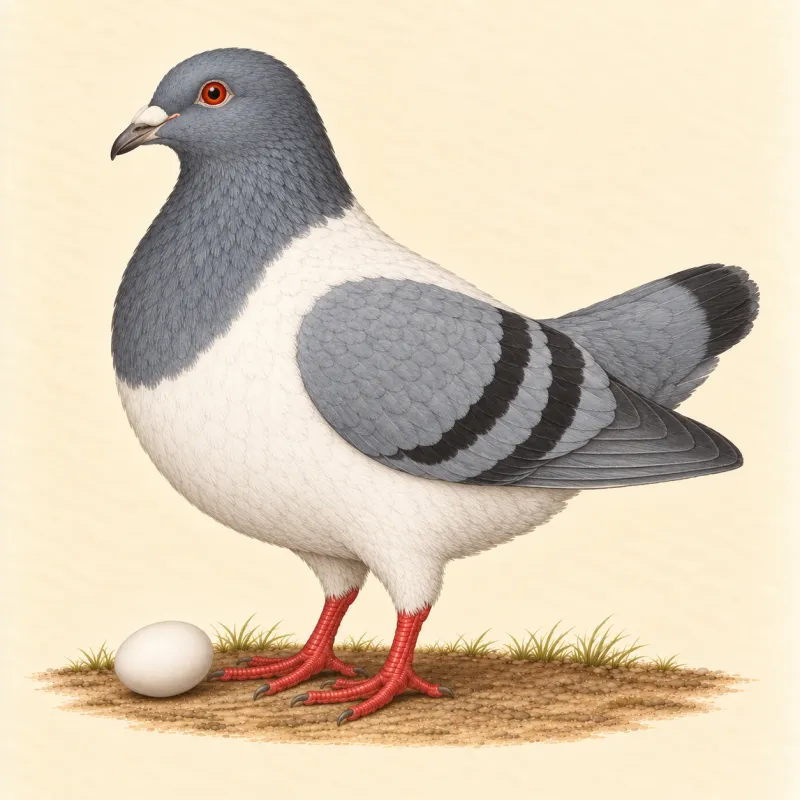
6 Modena
A short, cobby 'bird of curves' from Modena, shown as pied Gazzi or unmarked Schietti.
Item specifics: Modena
- Egg colour
- White
- Days to hatch
- 17-19
- Size
- About 10 in tall, 7 in long (North American standard); ring size C
- From
- Modena, Italy; the British show type is the English Modena
- UK status
- National Modena Club (founded 1910), NPA-affiliated
Why fanciers love it: Modena
The Modena takes its name from the Italian city where it was first bred, and geneticists describe it as an ancient Italian breed that was once raced. Today it is purely a show bird. Britain's type is the English Modena, promoted by a club founded in 1910. The North American standard pictures a bird ten inches tall and seven long, rounded from every angle, on clean bright red legs. Gazzi have a white body with coloured head, wings and tail.
Breeding: Modena
Modena pairs sit in turn on two eggs for 17 to 19 days and rear the downy, helpless squabs on crop milk. The American club's glossary lists Schietti as dominant over Gazzi, and a 2023 genetics study found a Gazzi Modena carrying a mutation in EDNRB2, the gene behind many pied patterns. Magnani birds carry the almond factor, which flecks the plumage with several colours.
Keeping: Modena
The Modena is smooth-feathered and clean-legged. Its loft must be dry and safe from cats, dogs and rats, with a shallow bath offered once or twice a week. To be shown, a bird must wear an NPA or other recognised ring, and from the 2026 season every bird at an NPA-affiliated show must be vaccinated against paramyxovirus.
Checked against: National Pigeon Association (GB) (Affiliated regional and breed clubs, The governing body of fancy pigeons in Great Britain, Bird Gathering Licence and Avian Influenza, Authorised sizes and distinguishing marks of rings), National Modena Club (North America) (Official National Modena Club standard (2023 revision), About us), Current Biology (2012), Entente Européenne, published by FESACOCUR, Wikipedia (Modena pigeon, Rock dove), PLOS Genetics (2023), British Trust for Ornithology, PLOS ONE (2012), Developmental Biology (2017), Small and Backyard Poultry (Extension Foundation).
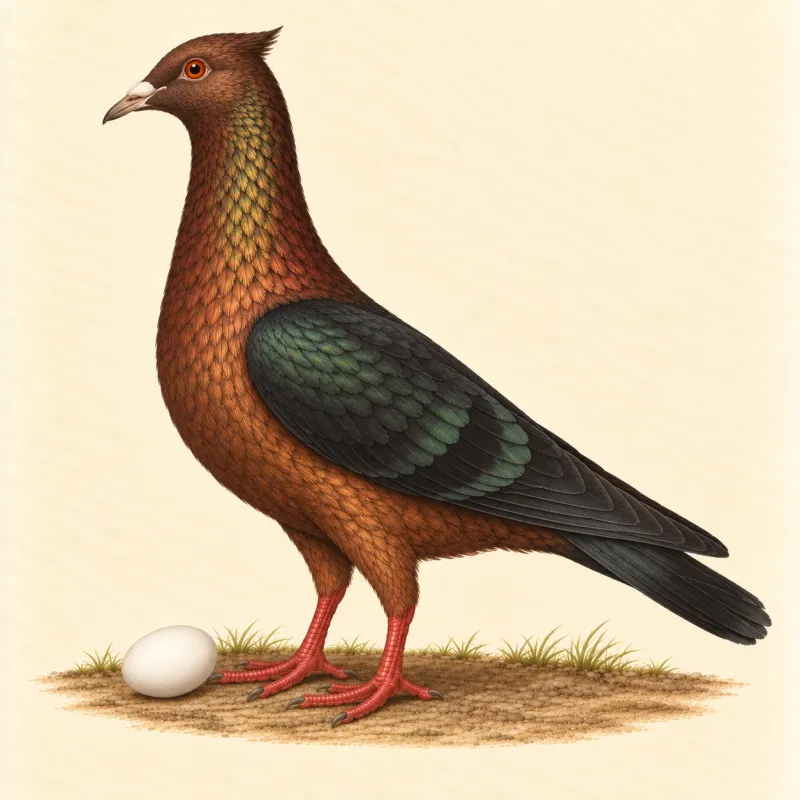
7 Archangel
A slender colour pigeon: a copper or gold body with a metallic sheen, against black, blue or white wings.
Item specifics: Archangel
- Egg colour
- White
- Days to hatch
- 17-19
- Size
- Medium build by the American club standard; 7 mm ring (American club and EE list), NPA ring size B
- From
- Probably the Dalmatian coast; standard held by Germany
- Temperament
- Sprightly and lively (American club standard)
- UK status
- Archangel Club, founded 1884, NPA-affiliated
Why fanciers love it: Archangel
Colour is nearly everything: the American club puts 80% of a bird's merit on colour and 20% on build. Head, neck, breast and belly are bronze, either fiery copper or golden yellow, while wings, back and tail are black with a beetle-green sheen, blue, or white. Germans call it the Gimpel, their word for bullfinch. Darwin listed it among the toy pigeons, which differ from the rock pigeon in little except colour. Britain's Archangel Club dates from 1884.
Breeding: Archangel
Archangels sit and rear like any pigeon: two eggs, both birds sharing 17 to 19 days on the nest, then crop milk. Colour is the hard part. The American standard admits it presents many difficulties and allows leniency for hens, which seldom match the cocks. A genome study found the breed unusually diverse, perhaps because its colour families are kept as somewhat closed lines.
Keeping: Archangel
The American standard describes a hardy, sprightly bird of medium build with clean legs, either peak crested or plain headed, wearing a 7 mm ring. It asks for good white light to read the sheen. Housing is the usual dry loft, secure from cats, dogs and rats. Birds going to NPA-affiliated shows must be vaccinated against paramyxovirus.
Checked against: National Pigeon Association (GB) (Affiliated regional and breed clubs, Authorised sizes and distinguishing marks of rings, Bird Gathering Licence and Avian Influenza), American Archangel Club, Entente Européenne, published by FESACOCUR, Charles Darwin, via Wikisource, Genome Biology and Evolution (2020), Wikipedia (Archangel pigeon, Rock dove), British Trust for Ornithology, PLOS ONE (2012), Developmental Biology (2017), Small and Backyard Poultry (Extension Foundation).
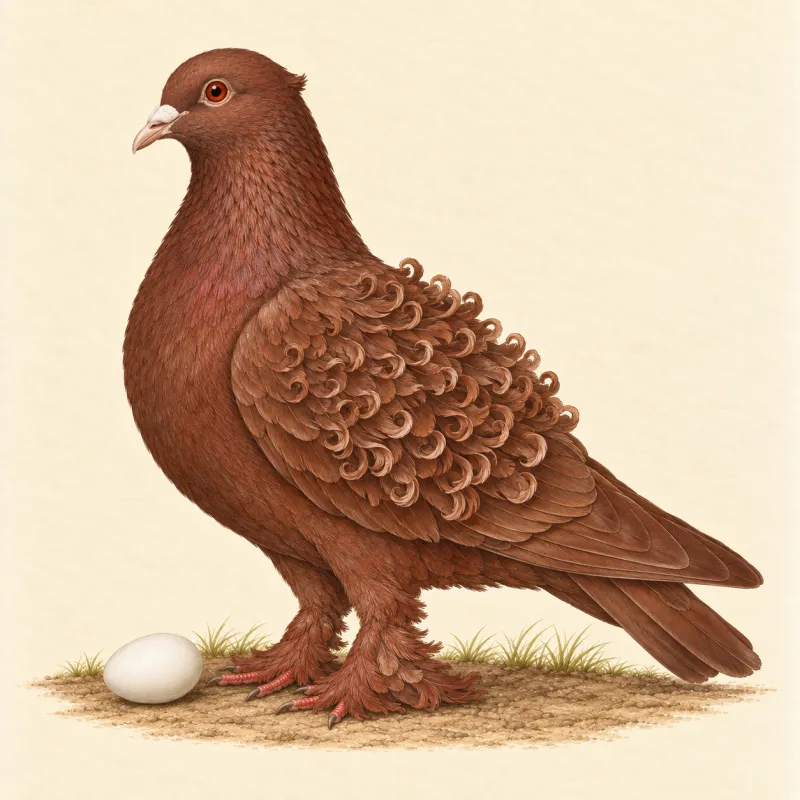
8 Frillback
A large pigeon in curls: the feathers of the wing shield, back and feet curl at the tips.
Item specifics: Frillback
- Egg colour
- White
- Days to hatch
- 17-19
- Size
- Large; NPA ring size D
- From
- Uncertain; Germany holds the European standard
- UK status
- Frillback Club, NPA-affiliated
Why fanciers love it: Frillback
Darwin described the Common Frill-back as considerably larger than the rock pigeon, with the feathers of the wing coverts curled upwards or backwards at the tips. Modern birds carry the curl on the wing shields, back and feet, and breeders want it right down to the ends of the foot feathers. Shell-crested and plain-headed birds both occur. Germany holds the European standard, where the breed sits among the structure pigeons. Britain has an NPA-affiliated Frillback Club.
Breeding: Frillback
Frillback pairs share the sitting on two eggs and feed crop milk like other pigeons. The curl is inherited, but not simply. Breeding experiments in the 1930s pointed to an incompletely dominant trait caused by two separate genes, named Cu1 and Cu2, whose identity is still unknown. Utah geneticists note that curly hair in people and dogs comes from keratin genes, but nobody knows yet if pigeons are the same.
Keeping: Frillback
The Frillback takes a large ring: NPA size D, the same as the English Pouter, and 9 mm on the European list. Like every pigeon it must be kept dry, in a loft that shuts out cats, dogs and rats, with a shallow bath once or twice a week. Show birds must be rung and, at NPA-affiliated shows, vaccinated against paramyxovirus.
Checked against: National Pigeon Association (GB) (Affiliated regional and breed clubs, Authorised sizes and distinguishing marks of rings, The governing body of fancy pigeons in Great Britain, Bird Gathering Licence and Avian Influenza), Entente Européenne, published by FESACOCUR, Developmental Biology (2017) (Genomic determinants of epidermal appendage patterning and structure in domestic birds (2017), Pigeonetics takes flight: evolution, development, and genetics of intraspecific variation), Charles Darwin, via Wikisource, Genetic Science Learning Center, University of Utah, Wikipedia (Frillback, Rock dove), Genome Biology and Evolution (2020), British Trust for Ornithology, PLOS ONE (2012), Small and Backyard Poultry (Extension Foundation).
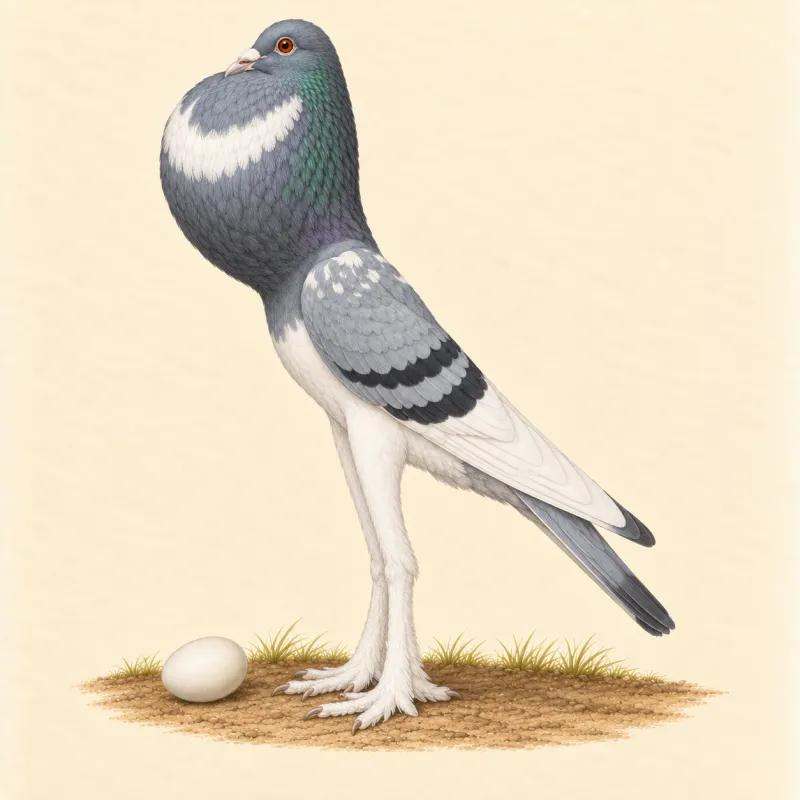
9 English Pouter
The tall, long-legged pigeon that blows its crop up like a balloon. Darwin thought it the most distinct.
Item specifics: English Pouter
- Egg colour
- White
- Days to hatch
- 17-19
- Size
- Large and upright, 19 in beak to tail (Darwin); NPA ring size D
- From
- England; Darwin thought the Dutch Pouter seemed to be its parent form
- Temperament
- Showy; cocks pout more than hens
- UK status
- United Pouter Club, NPA-affiliated
Why fanciers love it: English Pouter
Darwin called the improved English Pouter 'perhaps the most distinct of all domesticated pigeons' and wrote that its inflated crop 'may well excite astonishment and even laughter'. All pigeons can puff the crop slightly; this breed carries the habit to an extreme, the cocks more than the hens. It stands remarkably upright on long legs feathered down to the feet. By 1858 the standard already asked for a body of at least 18 inches and a 7 inch leg.
Breeding: English Pouter
Darwin's Pouters fed their own young: he heard the peas rattling in a cock's inflated crop as it flew up to feed nearly fledged squabs. Both birds sit and both give crop milk. He also recorded that where large size is wanted, as in Pouters, the ill effects of close inbreeding show sooner, and that pigeon breeders thought an occasional cross with another strain indispensable.
Keeping: English Pouter
Darwin called the Pouter a large bird, though not bulky, and measured one at 19 inches from beak to tail. It takes NPA ring size D and, at 11 mm, the largest European ring of the ten breeds here. The United Pouter Club caters for English, Pigmy and Brunner Pouters. Housing must be dry and secure from cats, dogs and rats, and show birds need paramyxovirus vaccination.
Checked against: National Pigeon Association (GB) (Affiliated regional and breed clubs, Authorised sizes and distinguishing marks of rings, Bird Gathering Licence and Avian Influenza), Charles Darwin, via Darwin Online, Charles Darwin, via Wikisource (The Variation of Animals and Plants under Domestication, chapter V (1868), The Variation of Animals and Plants under Domestication, chapter VI (1868), The Variation of Animals and Plants under Domestication, chapter XVII), Genetic Science Learning Center, University of Utah, Developmental Biology (2017) (Genomic determinants of epidermal appendage patterning and structure in domestic birds (2017), Pigeonetics takes flight: evolution, development, and genetics of intraspecific variation), Current Biology (2013), Entente Européenne, published by FESACOCUR, Wikipedia (English Pouter, Rock dove), Current Biology (2012), British Trust for Ornithology, PLOS ONE (2012), Small and Backyard Poultry (Extension Foundation).
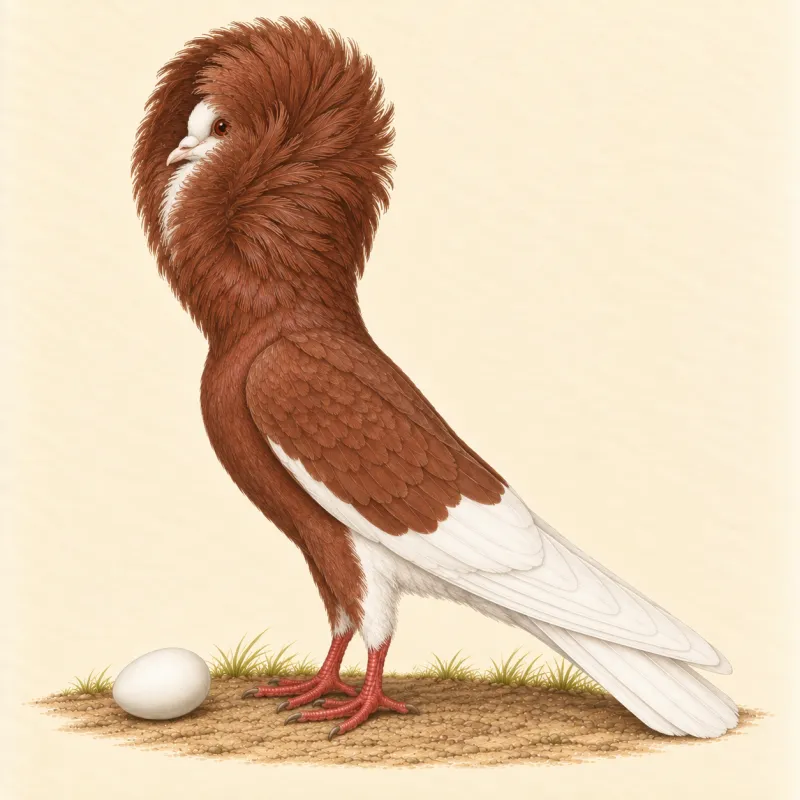
10 Jacobin
A quiet pigeon whose hood of reversed neck feathers almost encloses its head.
Item specifics: Jacobin
- Egg colour
- White
- Days to hatch
- 17-19
- Size
- Smaller than a rock pigeon, longer in wing and tail; NPA ring size B
- From
- Known before 1600; usually said to be from India
- Temperament
- Singularly quiet, seldom flying or moving about (Darwin)
- UK status
- British Jacobin Society (established 1896), NPA-affiliated
Why fanciers love it: Jacobin
The hood is built from neck feathers that grow the wrong way, up towards the head, and in the Jacobin it almost encloses the head and meets in front of the neck. Geneticists found that crested breeds share one mutation in the EphB2 gene. Darwin found the bird singularly quiet. The breed existed before 1600, when the hood was far less complete, and Queen Victoria favoured it. The British Jacobin Society dates from 1896.
Breeding: Jacobin
Like all pigeons, Jacobins lay two eggs, share the sitting and make crop milk for their downy, helpless squabs. The British Jacobin Society itself calls the breed challenging but rewarding. The crest is a recessive trait, so it shows only in birds that carry two copies. Hobbyists commonly move pigeon eggs to foster parents, which also lets the first pair lay again.
Keeping: Jacobin
The hood blocks the bird's sight in every direction except forwards. Extension advice groups the Jacobin with the Fantail, which it says should be confined to the loft and fly pen. Darwin's birds seldom flew or moved about. The breed takes NPA ring size B and an 8 mm European ring. Show birds need a recognised ring and, at NPA-affiliated shows, paramyxovirus vaccination.
Checked against: National Pigeon Association (GB) (Affiliated regional and breed clubs, Authorised sizes and distinguishing marks of rings, The governing body of fancy pigeons in Great Britain, Bird Gathering Licence and Avian Influenza), Science (2013), Charles Darwin, via Wikisource (The Variation of Animals and Plants under Domestication, chapter V (1868), The Variation of Animals and Plants under Domestication, chapter VI (1868)), Small and Backyard Poultry (Extension Foundation), Current Biology (2013), Charles Darwin, via Darwin Online, British Trust for Ornithology, Developmental Biology (2017), Entente Européenne, published by FESACOCUR, Genome Biology and Evolution (2020), Wikipedia (Jacobin pigeon, Rock dove), PLOS ONE (2012).
How pigeons hatch and rear their young
Pigeons hatch their own eggs. A pair lays two, a day or two apart, and cock and hen take turns to sit for 17 to 19 days. In the US Army's pigeon manual the hen sits from late afternoon to mid-morning and the cock takes the day shift. Both parents then feed the squabs crop milk, which they start to make two days before the first egg hatches.
That is why pigeon eggs are not an incubator project. In feeding trials an artificial copy of crop milk left squabs growing poorly or dying, so fanciers who need to move eggs put them under foster pairs. If you buy pigeon eggs, plan to set them under a sitting pair of your own.
Three rules to know in the UK. Keepers in England and Wales must register their birds within a month of starting. Only pigeons vaccinated against paramyxovirus may take part in shows or races. And under bird flu controls, flying can be limited to one hour, once a day.
Questions about pigeons
Can you hatch pigeon eggs in an incubator?
Hatching pigeon eggs in an incubator is not a practical project. Squabs are fed crop milk by both parents, and in feeding trials an artificial copy left squabs growing poorly or dying, so fanciers who need to move eggs put them under foster pairs.
How long do pigeon eggs take to hatch?
Pigeon eggs take 17 to 19 days to hatch, with cock and hen taking turns to sit.
How many eggs does a pigeon lay?
A pigeon lays two eggs to a clutch, a day or two apart.
Do you have to register pigeons in the UK?
Yes. Pigeon keepers in England and Wales must register their birds within a month of starting. Only pigeons vaccinated against paramyxovirus may take part in shows or races.
How we chose these ten
Ten of the breeds UK fanciers keep, set out from the flyers to the show birds. The choice is ours and nobody has measured it. British standards for fancy pigeons are mostly not published online, so measurements come from the clubs that do publish theirs, named in each entry, and several of the oldest descriptions are Charles Darwin's, who kept every breed he could get.
The plates are illustrations, not photographs. We made them with an AI image generator and checked each one against the breed's description, but a drawing is no substitute for seeing the birds, so ask a seller for photos of their own flock.
More from the breed book
Sources
Each entry lists the pages its facts were checked against. For the chapter as a whole: National Pigeon Association (GB): The governing body of fancy pigeons in Great Britain, Royal Pigeon Racing Association: Getting started, Current Biology (2013): Domestic pigeons (Shapiro and Domyan, 2013), BMC Genomics (2011): Histological and global gene expression analysis of the 'lactating' pigeon crop (Gillespie and others, 2011), British Trust for Ornithology: Rock dove, GOV.UK: Register as a keeper of less than 50 poultry or other captive birds, GOV.UK: Bird flu rules for racing pigeons and other captive birds, GOV.UK: Paramyxovirus infection, Charles Darwin, via Wikisource: The Variation of Animals and Plants under Domestication, chapter VI (1868), United States War Department, via Project Gutenberg: The Homing Pigeon, Technical Manual TM 11-410 (1945), Developmental Biology (2017): Pigeonetics takes flight: evolution, development, and genetics of intraspecific variation, PLOS ONE (2012): Functional Similarities between Pigeon 'Milk' and Mammalian Milk, Charles Darwin, via Wikisource: The Variation of Animals and Plants under Domestication, chapter XVII, Birds of the World, Cornell Lab of Ornithology: Rock Pigeon (Columba livia).
Spotted something out of date? Email hello@broodyeggs.co.uk.