Top 10 turkey breeds to hatch in the UK
Heritage turkeys mate naturally, raise their own young and come in far more colours than bronze. Nine of these ten are priority breeds on the Rare Breeds Survival Trust's watchlist, so a hatch does some good as well.
- Norfolk Black
- Bronze
- Bourbon Red
- Narragansett
- Slate
- Buff
- Crollwitzer (Pied)
- British White
- Harvey Speckled
- Royal Palm
| Variety | Egg colour | Stag weight | Temperament |
|---|---|---|---|
| Norfolk Black | Cream, brown speckles | 11.35 kg | Placid |
| Bronze | Cream to brown, speckled | Up to 18.1 kg | Friendly if handled young |
| Bourbon Red | Cream to brown, spotted | 14.9 kg | Friendly, active forager |
| Narragansett | Cream to brown, spotted | 14.9 kg | Calm; good mothers |
| Slate | Cream to brown, spotted | 10-12.7 kg | Placid |
| Buff | Speckled | Up to 12.7 kg | Alert but easy to manage |
| Crollwitzer (Pied) | Speckled | Up to 10 kg | Alert, keen forager |
| British White | Speckled | 10-12.7 kg | Varies with the strain |
| Harvey Speckled | Speckled | 10-12.7 kg | Not recorded |
| Royal Palm | Cream to brown, spotted | About 9-10 kg | Curious, good flyer |
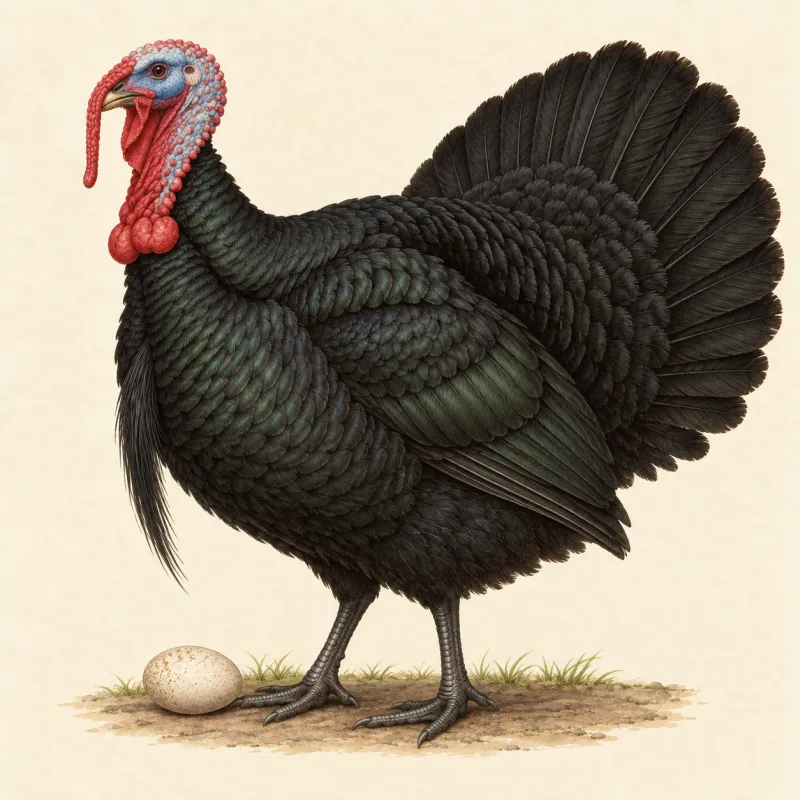
1 Norfolk Black
Believed to be Britain's first turkey variety: a dense black, placid bird with East Anglian roots.
Item specifics: Norfolk Black
- Egg colour
- Cream with brown speckles
- Eggs a year
- 40-70 (sources differ)
- Days to hatch
- 28
- Size
- Light; stag 11.35 kg (25 lb), hen 5.9-6.8 kg
- From
- England (Norfolk and East Anglia)
- Temperament
- Placid
- UK status
- RBST priority breed (2026-27 watchlist)
Why keepers love it: Norfolk Black
Turkeys reached England from Spain in 1526, and the black birds that farmers in East Anglia took to became the Norfolk Black, believed to be the first variety in Britain. Taken back to America in the 1600s and crossed with the Eastern wild turkey, it gave rise to the Slate, Narragansett and Bronze. RBST describes a placid bird, renowned for its meat, that takes about six months to mature. A Turkey Club UK survey in 2012 found it the most kept variety.
Hatching: Norfolk Black
Day-old poults are mostly black, with creamy white on the head, face, breast and abdomen. First feathers often show white or bronze that moults out, says The Livestock Conservancy. RBST gives a laying season of February to September and around 70 cream, brown-speckled eggs a year; the Conservancy says 40 to 50. Poults cannot regulate their body temperature for their first 10 days, so heat is essential.
Keeping: Norfolk Black
Black turkeys can fly and will roost in trees unless trained to come home. Keep them apart from chickens: the MSD Veterinary Manual warns that chickens carry blackhead with few signs, while mortality in turkeys is commonly 80 per cent or more.
Checked against: Turkey Club UK (Norfolk Black, Breed standards, History of the Turkey Club), The Poultry Club of Great Britain (Norfolk Black, Hatching, Rearing, and Care of Young Poultry), Rare Breeds Survival Trust (Norfolk Black, Watchlist: turkeys, Watchlist), The Livestock Conservancy, MSD Veterinary Manual, Penn State Extension.
Look for Norfolk Black turkey hatching eggs on Broody Back to the ten turkeys
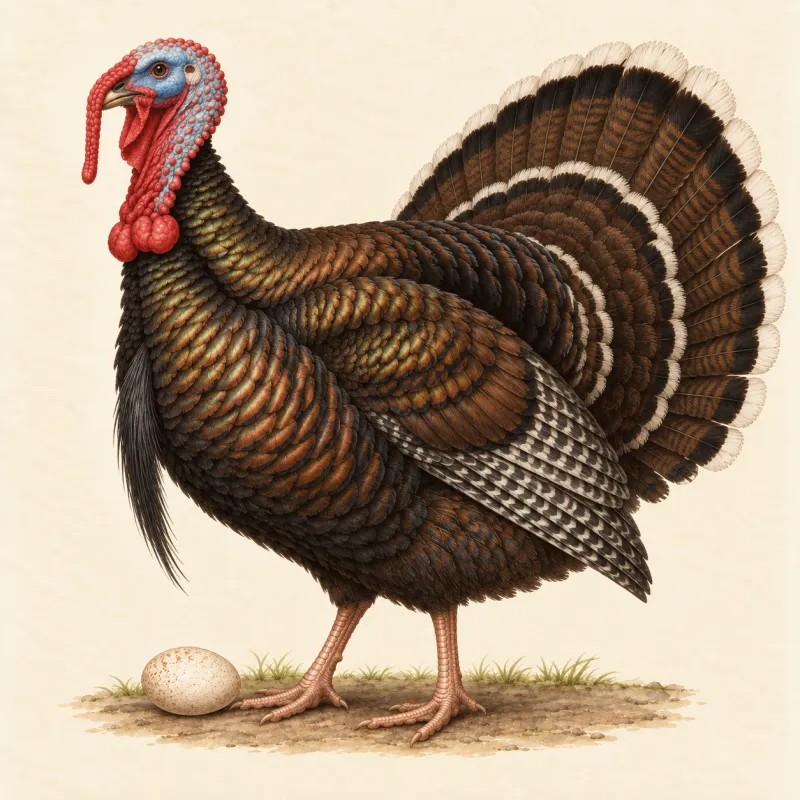
2 Bronze
The turkey closest in colour to the wild bird: heavy, metallic bronze and naturally bred.
Item specifics: Bronze
- Egg colour
- Cream to medium brown, speckled
- Eggs a year
- About 75
- Days to hatch
- 28
- Size
- Heavy; stag up to 18.1 kg (40 lb), hen up to 11.8 kg
- From
- Europe, then crossed with the Eastern wild turkey in the Americas
- Temperament
- Friendly if handled young; an active forager
- UK status
- RBST priority breed (2026-27 watchlist)
Why keepers love it: Bronze
The Bronze is the closest in colouring to the Eastern wild turkey, and Turkey Club UK's breed page calls it the most popular variety, hard to beat at exhibitions, although the club's own survey in 2012 found the Norfolk Black the most kept. Feathers on the back are rich copperish bronze, each ending in a narrow black band, and the tail finishes in a wide edging of white. It is often confused with the broad-breasted meat Bronze, which far outnumbers it. Since 1978 the British standard has covered the Mammoth Bronze and Cambridge Bronze under the one name.
Hatching: Bronze
Poults hatch with a light brown head, blotched and streaked dark brown. RBST says the sexes can be told apart at around twelve weeks, when the hen's breast feathers are edged with white and the stag's with black. It also warns that this is the variety most likely to produce off-coloured birds. The Livestock Conservancy gives about 75 eggs a year and calls the hens good mothers.
Keeping: Bronze
The Livestock Conservancy says some stags can stand up to 4 feet tall; too heavy to fly, they like to roam. Unlike the broad-breasted Bronze, which needs artificial insemination, it mates naturally. Turkey Club UK advises saddling hens before mating, heavy varieties especially.
Checked against: Turkey Club UK (Bronze, Breed standards, News and Show Dates, History of the Turkey Club), The Poultry Club of Great Britain (Bronze, Hatching, Rearing, and Care of Young Poultry), Rare Breeds Survival Trust (Bronze, Watchlist: turkeys, Watchlist), The Livestock Conservancy (Standard Bronze Turkey, Definition of a Heritage Turkey).
Look for Bronze turkey hatching eggs on Broody Back to the ten turkeys
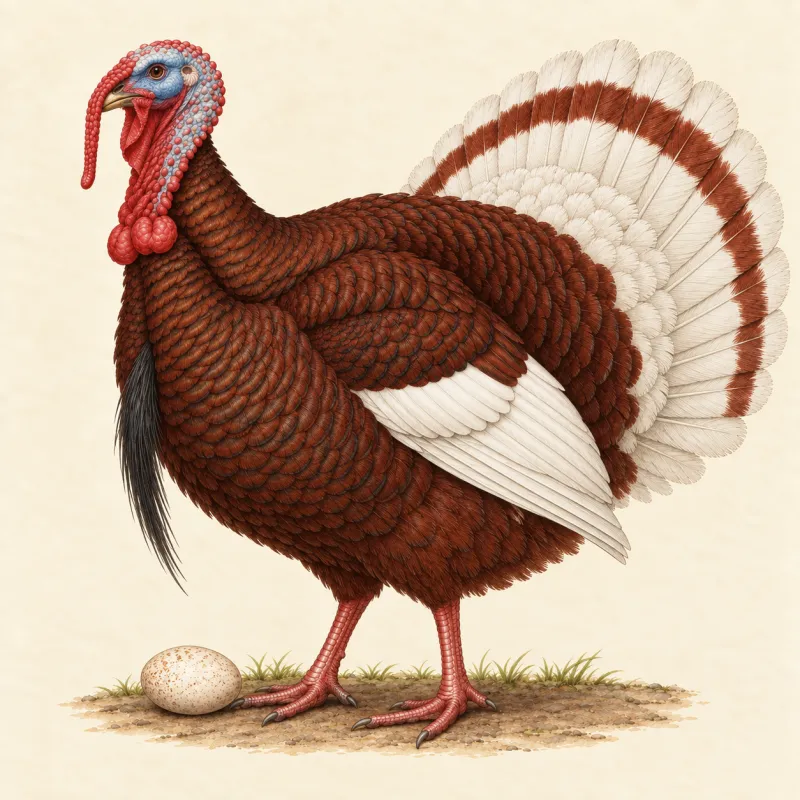
3 Bourbon Red
Chestnut mahogany with pure white flights and tail, bred in Kentucky and first named the Bourbon Butternut.
Item specifics: Bourbon Red
- Egg colour
- Pale cream to medium brown with spotting
- Days to hatch
- 28
- Size
- Heavy; stag 14.9 kg (33 lb), hen 8.1 kg (18 lb)
- From
- Bourbon County, Kentucky, USA
- Temperament
- Active forager; friendly with people
- UK status
- RBST priority breed (2026-27 watchlist)
Why keepers love it: Bourbon Red
Named after Bourbon County in Kentucky's Bluegrass region, where it originated in the late 1800s, the Bourbon Red was made from crosses of Buff, Bronze and White Holland turkeys. It was first called the Bourbon Butternut and only became popular once renamed. The stag is rich, dark chestnut mahogany with a very narrow black edging, set off by pure white flights and tail. America standardised it in 1909, and it was an important commercial variety there in the 1930s and 1940s.
Hatching: Bourbon Red
Poults hatch with a light reddish brown head and a light yellowish brown back carrying three dark brown stripes, the middle one broadest. Growing poults turn pale beige with white markings until the adult feathers emerge. Hens lack the stag's black edging and show a thread of white on each breast feather. Flights or tail with more than a third of any colour but white are a defect.
Keeping: Bourbon Red
RBST calls it an active forager that does best on pasture. The Livestock Conservancy finds the birds friendly, even affectionate, with people, though stags may be territorial with rival males, and notes that the light pin feathers leave a clean carcass.
Checked against: Turkey Club UK, The Poultry Club of Great Britain (Bourbon Red, Hatching, Rearing, and Care of Young Poultry), Rare Breeds Survival Trust (Bourbon Red, Watchlist: turkeys, Watchlist), The Livestock Conservancy.
Look for Bourbon Red turkey hatching eggs on Broody Back to the ten turkeys
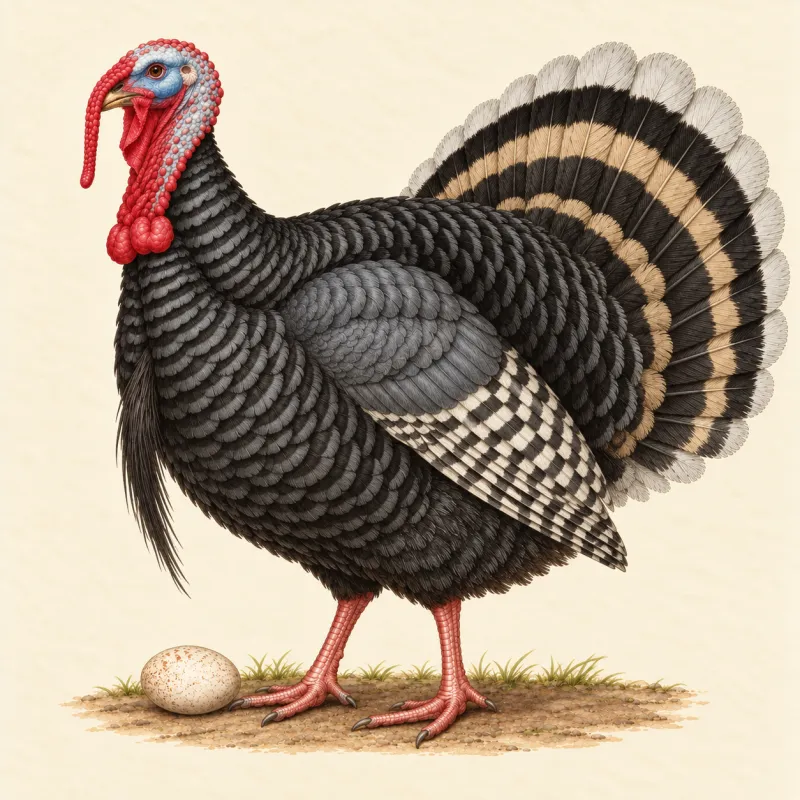
4 Narragansett
Steel grey, black and white New England turkey with calm, broody hens that are good mothers.
Item specifics: Narragansett
- Egg colour
- Cream to light brown, spotted
- Eggs a year
- 50-100 in a season
- Days to hatch
- 28
- Size
- Heavy; standard weights stag 14.9 kg (33 lb), hen 8.1 kg (18 lb); RBST gives the hen 10.4 kg
- From
- Narragansett Bay, Rhode Island, USA
- Temperament
- Calm; hens broody and good mothers
- UK status
- RBST priority breed (2026-27 watchlist)
Why keepers love it: Narragansett
Named after Narragansett Bay in Rhode Island, this is the Bronze pattern with steel grey and black in place of the copper. It is believed to descend from black turkeys taken from England and crossed with the Eastern wild turkey. An 1872 account describes flocks of one to two hundred birds raised from a dozen hens, and RBST says the variety has traditionally been known for a calm disposition, good maternal instincts and good egg production.
Hatching: Narragansett
The Livestock Conservancy says hens can lay 50 to 100 large, spotted eggs in a season with good fertility. It ranks the Narragansett among the broodier varieties, with hens sometimes used to hatch eggs for less broody ones. Poults have a yellowish grey head mottled with dark brown and are paler on the breast than Bronze poults, yet the two are very hard to tell apart until around six weeks.
Keeping: Narragansett
Heavy as they are, The Livestock Conservancy says they can fly and like to, run quickly, and will roost in trees unless confined or trained to go inside at night. They do well in cold weather. Dark pin feathers take extra effort to remove.
Checked against: Turkey Club UK, The Poultry Club of Great Britain (Narragansett, Hatching, Rearing, and Care of Young Poultry), Rare Breeds Survival Trust (Narragansett, Watchlist: turkeys, Watchlist), The Livestock Conservancy.
Look for Narragansett turkey hatching eggs on Broody Back to the ten turkeys
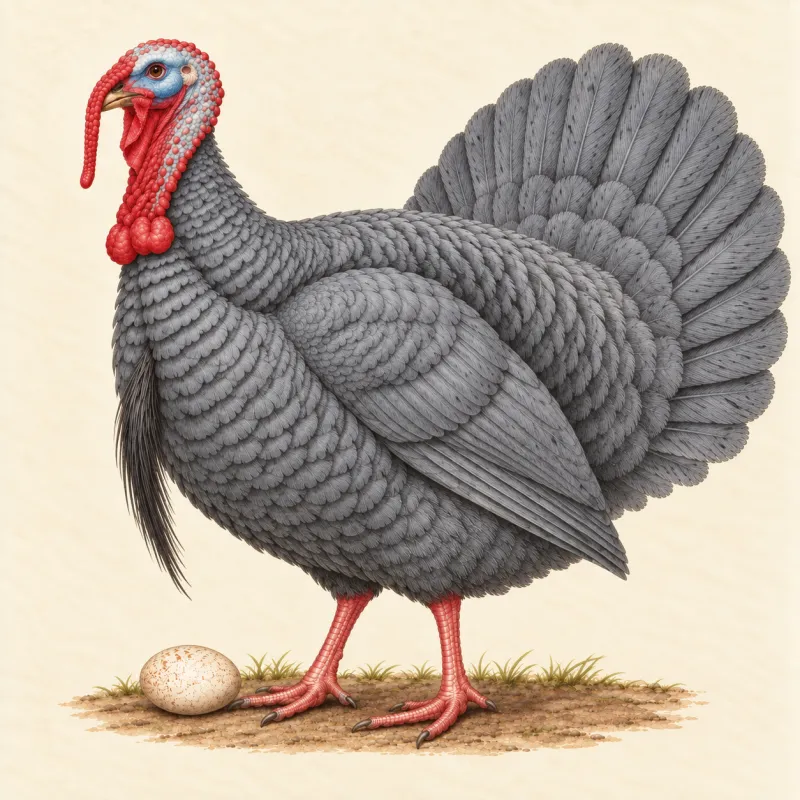
5 Slate
Slaty blue from head to tail, often flecked with black, and hard to breed to the ideal colour.
Item specifics: Slate
- Egg colour
- Cream or light brown, spotted
- Days to hatch
- 28
- Size
- Light; stag 10-12.7 kg, hen 5.4-8.1 kg
- From
- America
- Temperament
- Placid; some stags territorial
- UK status
- RBST priority breed (2026-27 watchlist)
Why keepers love it: Slate
The Slate is slaty blue throughout, and the standard allows the feathers to be dotted or flecked with black. RBST calls it highly sought after as an exhibition bird and critically rare worldwide. Its origin is poorly documented: the standard believes it came from Norfolk Blacks crossed with the Eastern wild turkey in America. Turkey Club UK keeps a separate standard for the Blue, an even blue without flecks, but knew of no Blue stock in the UK in 2024.
Hatching: Slate
Day-old poults are yellowish white on the head, neck and back with a definite tinge of blue. Two mutations, one dominant and one recessive, give slightly different shades, and The Livestock Conservancy calls the ideal colour challenging to breed. RBST warns that the Lavender form of the Blue can carry a lethal gene causing eye problems, even blindness, and that affected birds should not be bred from.
Keeping: Slate
RBST quotes stags up to 13.6 kg (30 lb), above the standard's top weight. The Livestock Conservancy knows the variety for a placid temperament, and says the birds are poor flyers and the hens not prolific layers. Entirely black feathers, and any brown or buff, are defects.
Checked against: Turkey Club UK (Slate, Blue), Rare Breeds Survival Trust (Slate, Blue, Watchlist: turkeys, Watchlist), The Livestock Conservancy, The Poultry Club of Great Britain.
Look for Slate turkey hatching eggs on Broody Back to the ten turkeys
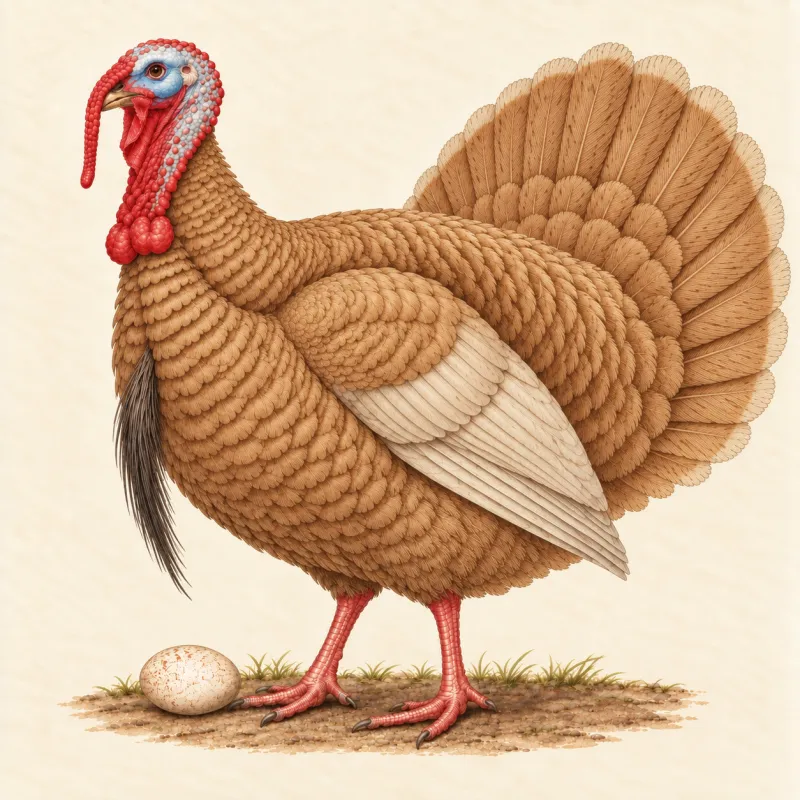
6 Buff
Deep cinnamon buff turkey that once had its own British club; good examples are now few.
Item specifics: Buff
- Egg colour
- Speckled; speckles deep brown to reddish chestnut
- Eggs a year
- About 60
- Days to hatch
- 28
- Size
- Light; stag up to 12.7 kg (28 lb), hen up to 8.1 kg
- From
- Standard lists America; stayed popular in Britain after the American standard lapsed
- Temperament
- Alert and active but easy to manage
- UK status
- RBST priority breed (2026-27 watchlist)
Why keepers love it: Buff
The Buff is named for the rich cinnamon colour of its body feathers. America recognised it in 1874 and dropped it in 1915, and today's American Jersey Buff is a separate 1940s creation. In Britain the Buff stayed popular, with its own Buff Turkey Club in the early 1900s. RBST is frank about it now: few good examples, and bloodlines so mixed with the Bourbon Red that Buffs with black markings and white in the tail abound.
Hatching: Buff
Poults hatch a pale creamy brown throughout. RBST puts production at around 60 eggs a year and says Buff hens, like other turkeys, make good mothers. Turkey hens store sperm very efficiently, so Turkey Club UK advises separating varieties before the end of December: one stray mating can leave a hen laying crossbred eggs for most of the season.
Keeping: Buff
RBST describes an alert, active bird that is still easy to manage. Relatively quick to mature, it ideally needs five to six months. The standard wants a deep cinnamon buff with very pale buff flights, and any black in the feathering is a defect.
Checked against: Turkey Club UK (Buff, News and Show Dates, Breed standards), The Poultry Club of Great Britain (Buff, Hatching, Rearing, and Care of Young Poultry), Rare Breeds Survival Trust (Buff, Watchlist: turkeys, Watchlist), The Livestock Conservancy.
Look for Buff turkey hatching eggs on Broody Back to the ten turkeys
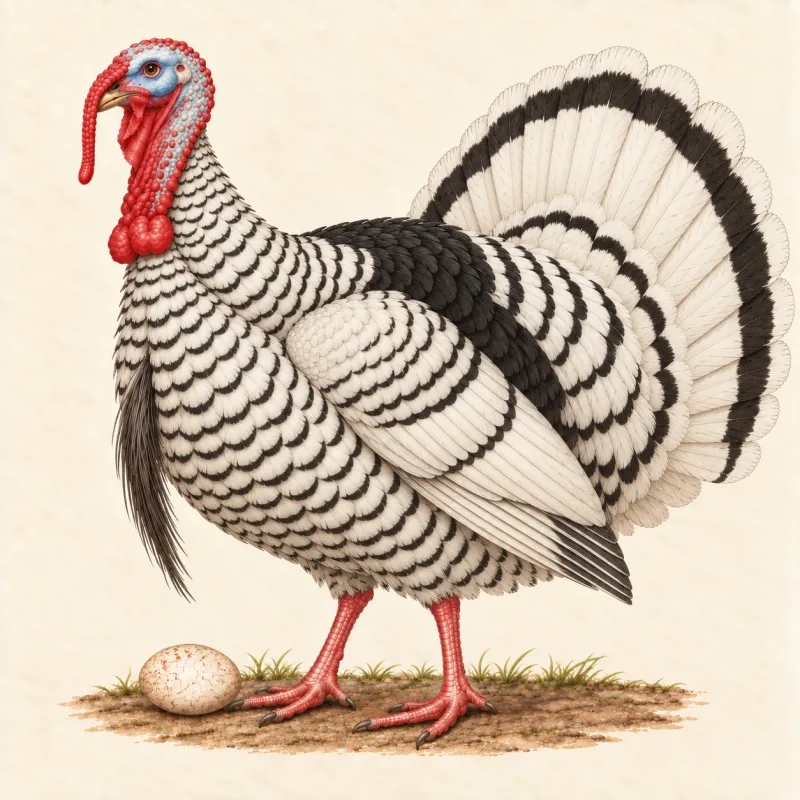
7 Crollwitzer (Pied)
White turkey edged and banded in black, small and upright, kept for the show pen and for its eggs.
Item specifics: Crollwitzer (Pied)
- Egg colour
- Speckled; speckles deep brown to reddish chestnut
- Days to hatch
- 28
- Size
- Light; stag up to 10 kg (22 lb), hen 5.4 kg (12 lb)
- From
- Europe; the Crollwitzer was bred at Cröllwitz, Halle, Germany
- Temperament
- Very alert and upright; a keen forager
- UK status
- RBST priority breed (2026-27 watchlist)
Why keepers love it: Crollwitzer (Pied)
Pied turkeys have existed in Europe since the 1700s, and the Crollwitzer takes its name from the district of Halle in Germany where it was bred. Every white neck feather ends in a fine black edge, the breast feathers finish in a black band to give the effect of fish scales, and the pure white tail carries a wide black band near the end. Turkey Club UK calls it very ornamental and a popular exhibition bird.
Hatching: Crollwitzer (Pied)
Poults hatch yellowish white all over. Pure white feathers grow through the down first, and the black markings only begin to appear at around six to eight weeks. The standard faults missing black edging, missing black bands in the tail and any brown colouring. Some poults of any variety struggle to find feed and water at first, and dipping their beaks teaches them where the water is.
Keeping: Crollwitzer (Pied)
RBST describes a very alert, upright bird that has never been selected for growth rate or muscling. It is a great forager, useful on a smallholding for eggs and pest control, though the carcass is smaller than other varieties. Look-alike Royal Palms are very few in the UK.
Checked against: Turkey Club UK (Crollwitzer (Pied), Breed standards), The Poultry Club of Great Britain (Crollwitzer (Pied), Hatching, Rearing, and Care of Young Poultry), Rare Breeds Survival Trust (Pied / Crollwitzer, Watchlist: turkeys, Watchlist), Landesverband der Rassegeflügelzüchter Sachsen-Anhalt, Wikipedia, Small and Backyard Poultry (Extension Foundation).
Look for Crollwitzer turkey hatching eggs on Broody Back to the ten turkeys
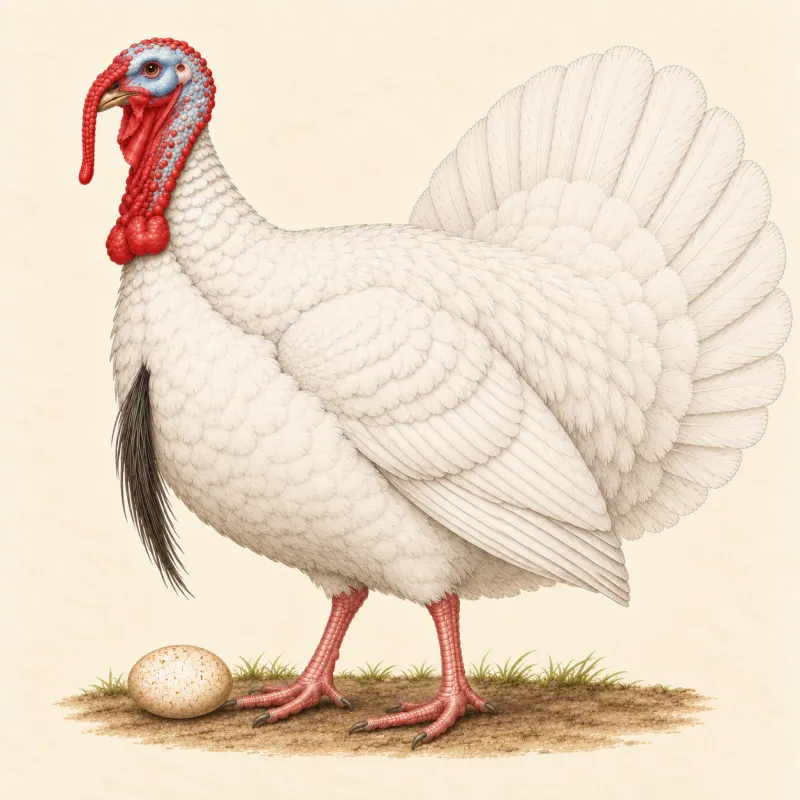
8 British White
Pure white turkey with pink legs, now exceedingly rare in its standard, non-commercial form.
Item specifics: British White
- Egg colour
- Speckled; speckles deep brown to reddish chestnut
- Days to hatch
- 28
- Size
- Light; stag 10-12.7 kg, hen 5.4-8.1 kg
- From
- Standard lists America; the British White was bred in the UK
- Temperament
- Depends heavily on the breeder's selection
- UK status
- RBST priority breed (2026-27 watchlist)
Why keepers love it: British White
White turkeys have turned up throughout the bird's history, and RBST notes that the Aztecs documented them. The British White, Austrian White and White Holland were all bred in the UK, and different strains were developed for the commercial sector. That is the difficulty now. RBST says standard versions are exceedingly rare and mainly commercially hybridised birds exist, and Turkey Club UK's own history carries a stark note for 2020: "List of White traditional turkeys critical."
Hatching: British White
Poults are pure white from the first day. Adults must be pure white too, free from cream or any other off-colour. With standard birds this scarce, parentage matters. Turkey Club UK notes that a hen can produce fertile eggs for most of the season from one mating, and that breeding pens need to be together in January for the eggs laid in March.
Keeping: British White
RBST puts hens at 9 kg (20 lb), above the standard's 8.1 kg. Legs and feet are pink flesh, and the iris is dark hazel. RBST says temperament is highly dependent on the breeder's selection: some select for aggressive birds, others choose docile.
Checked against: Turkey Club UK (White, Anatomy and Health Topics, History of the Turkey Club, News and Show Dates, Breed standards), The Poultry Club of Great Britain (White, Hatching, Rearing, and Care of Young Poultry), Rare Breeds Survival Trust (British White, Watchlist: turkeys, Watchlist).
Look for British White turkey hatching eggs on Broody Back to the ten turkeys
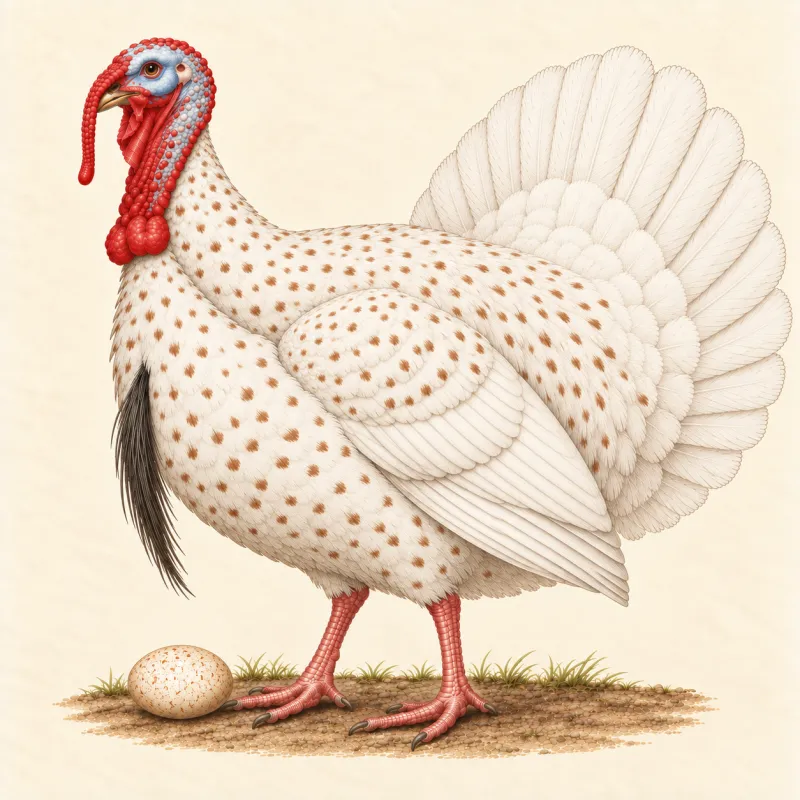
9 Harvey Speckled
Creamy white with distinct cinnamon speckles, developed in Cornwall and standardised in March 2016.
Item specifics: Harvey Speckled
- Egg colour
- Speckled; speckles deep brown to reddish chestnut
- Days to hatch
- 28
- Size
- Light; stag 10-12.7 kg, hen 5.4-8.1 kg
- From
- Cornwall, England
- UK status
- RBST priority breed (2026-27 watchlist)
Why keepers love it: Harvey Speckled
Mr D. C. Harvey of Cornwall developed this speckled turkey in the late 20th century, at first as a light commercial bird. The Poultry Club passed its standard in March 2016, and RBST now lists it as a priority breed alongside the older varieties. The colour is the whole point: creamy white overall with distinct cinnamon speckles, creamy white flights and tail, and salmon pink legs that age to horn. Hens are often less heavily speckled than stags.
Hatching: Harvey Speckled
The standard polices the speckling closely: speckles that run into each other, areas of solid colour, barring, or any colour other than cinnamon are all defects. Turkey eggs take 28 days to hatch and are roughly twice the size of chicken eggs. Poults need turkey crumbs with 28 per cent protein for their first three to four weeks; chick crumbs are too low in protein.
Keeping: Harvey Speckled
Turkey Club UK says turkeys are easy to keep provided there are not too many in a small area, that an average garden could accommodate a pair, and that they prefer a round perch 5 to 8 cm across.
Checked against: Turkey Club UK (Harvey Speckled, Anatomy and Health Topics, History of the Turkey Club, About, Breed standards), The Poultry Club of Great Britain (Harvey Speckled, Hatching, Rearing, and Care of Young Poultry), Rare Breeds Survival Trust (Harvey Speckled, Watchlist: turkeys, Watchlist), Penn State Extension, Small and Backyard Poultry (Extension Foundation).
Look for turkey hatching eggs on Broody Back to the ten turkeys
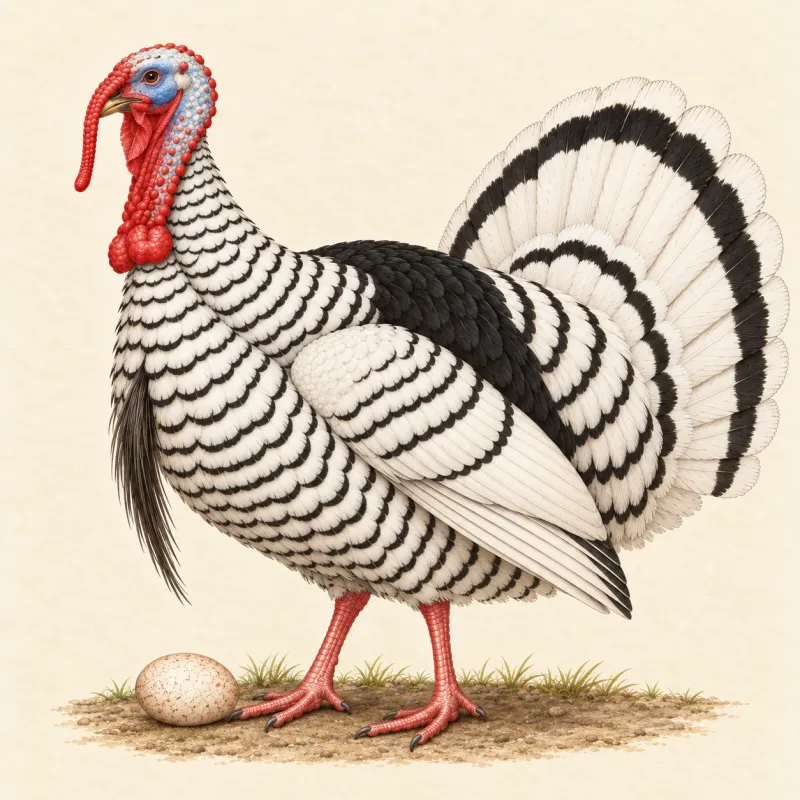
10 Royal Palm
Small American look-alike of the Crollwitzer: white with metallic black edging, a good flyer and forager.
Item specifics: Royal Palm
- Egg colour
- Pale cream to medium brown with spotting
- Eggs a year
- Under 20, laid in spring
- Days to hatch
- 28
- Size
- Small; stag about 9-10 kg, hen about 5.4 kg
- From
- Lake Worth, Florida, USA
- Temperament
- Curious and people-friendly; an active forager and good flyer
- UK status
- Not standardised in the UK; very few here (RBST)
Why keepers love it: Royal Palm
In America the Palm pattern first appeared in the 1920s in a mixed flock of Black, Bronze, Narragansett and wild turkeys on a farm in Lake Worth, Florida, and the American standard recognised the Royal Palm in 1971. It is white with sharply contrasting metallic black edging, similar to Europe's Pied or Crollwitzer, which is the variety with a British standard. Turkey Club UK lists it only as a similar-coloured variety from the USA, and RBST says very few are in the UK.
Hatching: Royal Palm
The Livestock Conservancy says hens lay under 20 pale cream to medium brown spotted eggs in the spring, far fewer than the 50 to 100 it quotes for the Narragansett. Hens are broody and can be good mothers. Stags are usually non-aggressive with people, especially if handled frequently as poults. Incubation takes 28 days.
Keeping: Royal Palm
The Livestock Conservancy describes active foragers and good flyers, best kept behind adequate fencing so they do not wander, which will roost in trees if not given shelter. It adds that stags may pick on other species kept with them.
Checked against: The Livestock Conservancy (Royal Palm Turkey, Narragansett Turkey), Turkey Club UK (Crollwitzer (Pied), Breed standards), Rare Breeds Survival Trust, The Poultry Club of Great Britain.
Look for Royal Palm turkey hatching eggs on Broody Back to the ten turkeys
Hatching turkey eggs: the basics
Turkey eggs take 28 days. University extension guidance for a forced-air incubator is 99 to 100°F (37.2 to 37.8°C), with humidity of 58 to 60 per cent until three days before the hatch and 65 per cent or more after that. Stop turning after day 25. The Poultry Club's advice to UK keepers is to go easy on adding water.
Poults are harder to start than chicks. They cannot regulate their own body temperature for the first ten days, some need their beaks dipped to find water, and they need a turkey starter feed with 28 per cent protein. Keep them away from chickens and from ground chickens have used: chickens carry blackhead with few signs, and in turkeys it is usually fatal.
Questions about turkeys
How long do turkey eggs take to hatch?
Turkey eggs take 28 days. Turning stops after day 25.
What colour are turkey eggs?
Turkey eggs are cream to light brown, with brown speckles or spots.
Can you keep turkeys with chickens?
Keep turkeys apart from chickens, and off ground chickens have used. Chickens carry blackhead with few signs, and the MSD Veterinary Manual puts mortality in turkeys at commonly 80 per cent or more.
How many eggs does a turkey lay in a year?
A turkey lays far fewer eggs than a hen. Published figures for these varieties run from under 20 for the Royal Palm to about 75 for the Bronze and 50 to 100 for the Narragansett.
Which turkey breeds are rare?
Nine of the ten turkeys in this chapter are priority breeds on the Rare Breeds Survival Trust's watchlist. The tenth, the Royal Palm, is an American variety with very few birds in the UK.
How we chose these ten
Nine of the ten have a breed standard at Turkey Club UK. The tenth, the Royal Palm, is the American look-alike of the Crollwitzer. The choice is ours and nobody has measured it. Every figure was checked against the sources listed with each entry, and where they disagree we give the range. Each plate shows one bird with an egg of the colour the breed lays, even where the bird drawn is the male.
The plates are illustrations, not photographs. We made them with an AI image generator and checked each one against the breed's description, but a drawing is no substitute for seeing the birds, so ask a seller for photos of their own flock.
More from the breed book
Sources
Each entry lists the pages its facts were checked against. For the chapter as a whole: Turkey Club UK: Breed standards, Rare Breeds Survival Trust: Watchlist: turkeys, Mississippi State University Extension: Important incubation factors, Penn State Extension: Small-flock turkey production, MSD Veterinary Manual: Histomoniasis in poultry, The Poultry Club of Great Britain: Hatching, Rearing, and Care of Young Poultry, Mississippi State University Extension: Incubation duration periods, The Livestock Conservancy: Definition of a Heritage Turkey, The Livestock Conservancy: Narragansett Turkey, Rare Breeds Survival Trust: Buff, The Poultry Club of Great Britain: Egg Production, The Livestock Conservancy: Black Turkey, Small and Backyard Poultry (Extension Foundation): Raising meat turkeys in small or backyard flocks, Turkey Club UK: News and Show Dates.
Spotted something out of date? Email hello@broodyeggs.co.uk.